

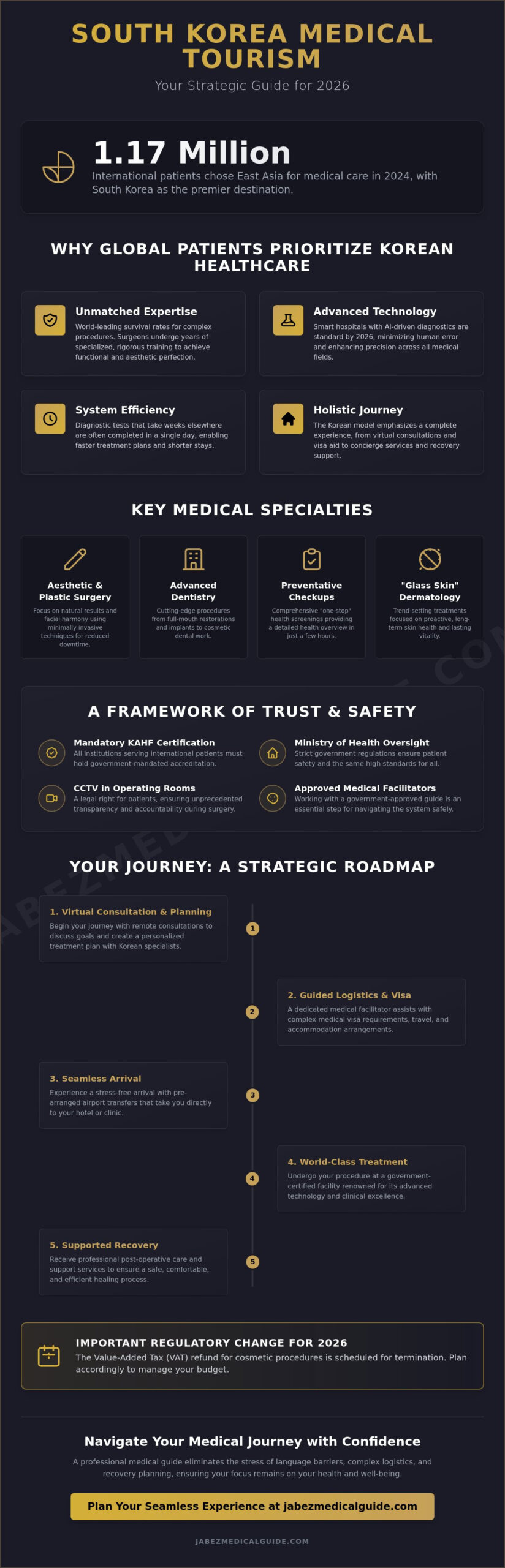
In 2024, a record-breaking 1.17 million international patients traveled to East Asia for treatment, proving that medical tourism south korea has evolved into the gold standard for global healthcare. It’s natural to feel a mix of excitement and hesitation when considering surgery in a foreign country. You might worry about potential communication barriers with surgeons or feel overwhelmed by the complexities of medical visa requirements and recovery logistics while traveling alone.
This guide provides the professional reassurance and clear roadmap you need to move forward with absolute confidence. We’ll explain how the 2026 “Medical Korea” initiative and mandatory KAHF certifications ensure your safety through every step of the process. You’ll learn about the latest regulatory changes, such as the legal right to CCTV recording in operating rooms and the 2026 termination of VAT refunds for cosmetic procedures. From coordinating plastic surgery or dental procedures to arranging airport transfers and recovery support, this overview prepares you for a seamless, well-organized experience in the world’s most advanced medical hub.
Key Takeaways
- Identify the core growth drivers and specialized expertise that define the landscape of advanced medical care in 2026.
- Explore the top medical sectors, including dentistry and aesthetic transformations, that maintain Korea’s reputation for world-class results.
- Learn how to verify hospital safety through government-mandated accreditation and the role of the Ministry of Health and Welfare.
- Navigate the complexities of medical tourism south korea with a step-by-step planning roadmap for your travel and treatment.
- Understand the logistical advantages of using a dedicated coordinator to manage medical visas, airport transfers, and your recovery support.
Understanding the Landscape of Medical Tourism in South Korea for 2026
In 2026, the concept of medical tourism in South Korea represents far more than just traveling for a procedure. It’s a sophisticated, government-regulated ecosystem where clinical excellence meets meticulous hospitality. While many patients initially look abroad to save costs, those choosing Korea prioritize the synergy of speed, advanced technology, and specialized expertise that few other nations can match. The healthcare sector here operates under stringent oversight, ensuring that international patients receive the same high standards of care as local residents.
There’s a subtle but important distinction between ‘medical travel’ and ‘medical tourism.’ While the former often focuses solely on the clinical event, the 2026 Korean model emphasizes a holistic journey. This includes everything from initial virtual consultations to recovery support and specialized concierge services. To ensure patient safety, the government mandates that all institutions catering to international visitors are registered and insured. Working with a government-approved medical facilitator has become an essential safety step. These partners act as your navigator for medical visa assistance, airport pick-up logistics, and language support, removing the friction often associated with foreign healthcare systems.
Why International Patients Prioritize Korean Healthcare
South Korea consistently reports some of the highest survival rates globally for complex procedures, including organ transplants and oncology. This success stems from a cultural emphasis on precision and a drive for aesthetic and functional perfection. Patients often find that the integration of traditional wellness practices with Western surgical precision offers a more balanced path to healing. The efficiency of the system is also a major draw; diagnostic tests that might take weeks in other countries are often completed within a single day here, allowing for faster treatment and shorter stays away from home.
The Synergy of Innovation and Patient Safety
The Korean government continues to invest billions into medical R&D to maintain its global leadership. By 2026, smart hospitals utilizing AI-driven diagnostic tools have become the standard, significantly reducing the margin for human error. These innovations aren’t limited to major general hospitals. The field of plastic surgery korea often serves as the primary gateway for international patients, but the standards of safety and innovation found in aesthetic clinics are mirrored across the entire healthcare system. This technological edge, combined with mandatory CCTV in operating rooms and government-certified safety protocols, provides the peace of mind that modern medical tourists demand.
Key Medical Specialties Driving Global Interest
Korea’s reputation as a global medical hub is built on a foundation of specialized excellence. While it’s often called the “World Capital” of aesthetic transformations, the scope of medical tourism south korea extends into life-saving and preventative care. A 2024 academic review of South Korea’s Healthcare Competitiveness and Strategy highlights how the nation leverages cutting-edge technology to maintain a significant edge over other medical destinations. This competitive drive ensures that every sector, from dentistry to oncology, meets world-class benchmarks.
Beyond aesthetic surgery, there’s a growing demand for preventative medical tourism. Comprehensive health checkups are a major driver of this interest. These “one-stop” screenings provide a detailed overview of a patient’s health in just a few hours. For younger travelers, the “Glass Skin” dermatology trend has become a significant draw. This focus on long-term skin health through personalized dermatology treatment management reflects a broader shift toward proactive healthcare. Patients today seek treatments that offer lasting vitality rather than just temporary fixes.
Advanced Aesthetic and Plastic Surgery Standards
In 2026, the industry has shifted toward “natural results.” Patients no longer seek obvious changes but rather subtle enhancements that prioritize facial harmony. Surgeons undergo years of rigorous, specialized training to master minimally invasive techniques that reduce downtime and scarring. One of the most critical decisions you’ll face is understanding korean hospital vs private clinic plastic surgery options, as the scale and specialization of your chosen facility can directly influence your results and recovery experience. Safety remains paramount, especially during the vulnerable days following a procedure. Utilizing professional post-op care services korea ensures that your healing process is monitored by experts who understand these specific surgical nuances and can provide the necessary recovery support.
Specialized Care: From Dental Implants to Hair Restoration
Precision is the hallmark of Korean dental and hair restoration services. Dental tourism packages are designed for both speed and accuracy. Many clinics utilize 3D imaging and digital impressions to complete complex implants in a fraction of the time required in Western countries. Similarly, hair restoration specialists have perfected advanced FUE (Follicular Unit Extraction) and FUT (Follicular Unit Transplantation) techniques. Those considering a hair transplant in Korea will find that these procedures often incorporate robotic-assisted surgery to ensure consistent graft survival and natural-looking density for international patients.
Managing these specialized appointments alongside international travel logistics can be complex. Choosing a partner for specialized treatment coordination allows you to focus entirely on your results while every detail of your journey is handled with professional care.
Evaluating the Safety and Regulation of the Healthcare System
Choosing a medical destination involves more than comparing costs; it requires a deep understanding of the safety nets in place for international patients. Safety is built into the national infrastructure of medical tourism south korea. The Ministry of Health and Welfare oversees a strict regulatory framework designed specifically to protect foreign visitors. This oversight ensures that every clinic or hospital you visit adheres to high clinical standards and ethical practices. You aren’t just a visitor; you’re a patient protected by a system that values transparency and accountability.
The “Medical Korea” initiative is a multi-billion dollar government strategy that prioritizes patient rights. For instance, by 2026, the law making CCTV recording in operating rooms a legal right for all patients is fully established. This provides an unprecedented level of verification and peace of mind. Non-residents also benefit from strict malpractice regulations. Korean law requires medical institutions catering to foreign patients to hold mandatory insurance, providing a clear path for resolution if any issues arise during your care.
Accreditation Standards and International Certifications
Many top-tier Korean hospitals hold JCI (Joint Commission International) accreditation, which is a global benchmark for patient safety. However, the internal KAHF (Korean Accreditation Program for Hospitals Serving Foreign Patients) standards are often even more rigorous. To earn this certification from the Ministry of Health and Welfare, institutions must meet over 100 stringent safety criteria. Additionally, government-approved facilitators must undergo a rigorous biennial re-certification process to ensure they maintain the highest standards of patient advocacy and logistical support.
Addressing Common Myths and Misconceptions
One common concern is the language barrier. In reality, hospitals serving international patients are legally required to provide certified medical translators. These professionals ensure that every detail of your treatment plan is clearly understood by both you and your surgeon, preventing any communication-related anxiety. We’ve found that this level of support is vital for a stress-free experience.
There’s also a misconception that “fast care” implies “rushed care.” The efficiency of the Korean medical model is actually a result of high-volume experience and advanced digital integration. It doesn’t mean your surgeon is cutting corners; it means the system is optimized for precision. Finally, price transparency has significantly improved. While the 10% VAT refund for cosmetic procedures ended on January 1, 2026, the government continues to monitor and standardize pricing to prevent hidden costs for foreign visitors. This level of organization allows you to plan your journey with financial clarity and professional reassurance.
Planning Your Journey: A Strategic Roadmap for 2026
Success in medical tourism south korea depends on a methodical approach. It’s about building a bridge between your current health and your desired outcome with zero room for error. A strategic roadmap ensures that every clinical and logistical detail is managed before you ever board a plane. This preparation alleviates the anxiety often associated with international surgery and sets the stage for a smooth recovery.
Your planning should follow five essential steps to ensure safety and clarity:
- Step 1: Specialist Identification. Research doctors who are not only board-certified but also operate within KAHF-accredited institutions. Focus on those who specialize specifically in your desired procedure.
- Step 2: Virtual Consultation. In 2026, a secure video consultation is the professional standard. Use this time to establish a treatment plan, receive a detailed cost estimate, and verify the surgeon’s communication style.
- Step 3: Visa and Legal Entry. Secure your medical visa and complete any mandatory digital health pass requirements.
- Step 4: Comprehensive Logistics. Coordinate your flights, airport pick-up, and specialized recovery accommodation that supports post-surgical needs.
- Step 5: Post-Operative Schedule. Finalize your follow-up appointments and local recovery support services before you depart your home country.
Navigating Logistics and Medical Visa Requirements
The C-3-3 medical visa category is specifically designed for international patients. To qualify, you’ll need an official invitation from a registered medical institution or a certified facilitator. This visa is essential because it allows for a legal stay tailored to your treatment and recovery duration. We highly recommend utilizing korea medical visa assistance to avoid common application delays or document errors. Additionally, be aware of the 2026 digital health pass requirements, which serve as a verified record of your health status for entry into the country.
Planning for Success: Guidance for Patients from the USA
Traveling from North America requires extra attention to the physical toll of long-haul flights. Managing circulation and hydration is vital, especially when returning home after a procedure. We suggest using a getting surgery in korea from usa planning guide to address these specific challenges. Effective time-zone management is also crucial for your virtual pre-op and post-op consultations. Coordinating these meetings during overlapping business hours ensures you have the full attention of your medical team without the stress of midnight calls. For a seamless experience, you can schedule a consultation with a professional coordinator to manage these complex logistical details on your behalf.
The Essential Role of a Medical Guide and Facilitator
Booking a procedure directly with a hospital might seem straightforward, but it often leaves the patient to navigate complex logistics without a local advocate. A professional facilitator serves as your dedicated navigator throughout the entire medical tourism south korea experience. This partnership transforms a potentially overwhelming trip into a structured and supported journey. While the hospital focuses on the clinical outcome, your guide prioritizes your comfort, safety, and personal peace of mind.
A specialized concierge acts as a bridge between your home environment and the advanced medical systems in Korea. They handle the essential details that are difficult to manage from afar, such as arranging airport pick-up and drop-off or coordinating pharmacy visits for post-operative prescriptions. This level of organization is especially vital for those traveling alone, providing a steadying influence and ensuring that no detail of your care plan is overlooked. It’s about having a professional partner who understands both the local culture and the high standards you expect.
Bridging the Gap: Professional Medical Translation
General translators often lack the precise vocabulary required for clinical consultations. In the Korean healthcare system, medical interpreters must undergo a rigorous certification process to ensure they can accurately convey surgical nuances, potential risks, and patient history. This ensures that your surgeon understands your exact aesthetic or functional goals without any ambiguity. Clear communication through a certified professional directly impacts surgical safety and ensures that your expectations align with the final results.
Comprehensive Support: From Consultation to Recovery
A professional facilitator provides an end-to-end service model that addresses the logistical and emotional challenges of international care. This includes providing expert medical visa assistance to prevent application errors that could delay your treatment. Once you arrive, the focus shifts to recovery support services, where your guide helps manage post-operative logistics and medication schedules. Whether you are here for hair restoration services or dental procedure coordination, having a local partner ensures your focus remains entirely on healing. If you’re seeking a managed, stress-free experience with world-class care, you can schedule your coordination consultation to begin your journey with confidence.
Secure Your Future with Precision and Care
Navigating the landscape of medical tourism south korea in 2026 requires a balance of clinical research and meticulous logistical planning. You’ve seen how the combination of government-mandated safety protocols, such as mandatory CCTV and KAHF accreditation, provides a foundation of trust for international patients. By following a strategic roadmap and understanding the specialized standards of Korean healthcare, you can transform your medical goals into a reality with minimal stress. Professional coordination ensures that your focus remains on recovery while every detail, from medical visa assistance to airport transfers, is handled by experts.
We invite you to start your journey with a personalized consultation from Jabez Medical Guide. Our team is partnered with government-approved medical institutions and provides professional certified medical translation alongside comprehensive 24/7 concierge support. You deserve a journey that is as seamless as it is transformative. We look forward to being your reliable navigator in the world’s leading medical destination.
Frequently Asked Questions
Is medical tourism in South Korea safe for international patients?
Yes, safety is a primary focus of the national healthcare infrastructure for medical tourism south korea. In 2026, all patients have a legal right to CCTV recording in operating rooms, and medical institutions must hold mandatory insurance for foreign patients. These regulations, overseen by the Ministry of Health and Welfare, ensure a high level of accountability and clinical excellence for every visitor.
Do I need a special visa to travel to Korea for medical treatment?
Yes, most international patients require a C-3-3 medical visa to enter the country for treatment. This specific visa category is designed for those seeking healthcare and requires an official invitation from a registered medical institution or a certified facilitator. Securing professional medical visa assistance helps ensure your documentation is accurate and prevents potential entry delays.
How much can I save on medical procedures in South Korea compared to the USA?
Patients typically find that medical costs in Korea are between 30% and 70% lower than those in the United States. These savings apply to high-demand fields like hair restoration and dental procedures without compromising the quality of care. While prices are more affordable, the technology and expertise available often exceed Western standards, providing exceptional value for international travelers.
Will the medical staff in Korean hospitals speak English?
While many surgeons are proficient in English, hospitals serving foreign patients are legally required to provide certified medical translators. This ensures that every clinical detail and surgical expectation is communicated with total precision. Using a facilitator for your medical tourism south korea journey provides an extra layer of support, ensuring you have an advocate who speaks your language at every appointment.
What happens if I experience complications after returning home?
It’s standard practice to establish a clear follow-up plan with your surgeon before you depart. Most reputable institutions provide digital consultation options to monitor your healing process remotely. If complications occur, your medical facilitator can act as a bridge, coordinating with the clinic to review your case and provide guidance on the necessary next steps for your local healthcare provider.
Can a medical facilitator help with my visa application and hotel booking?
Yes, a professional facilitator manages these essential logistical details to ensure a stress-free experience. They provide comprehensive medical visa assistance and can coordinate recovery-friendly accommodations tailored to your specific needs. From airport pick-up and drop-off to scheduling your initial consultations, a facilitator acts as a reliable navigator for your entire journey.
How do I verify if a Korean hospital is accredited for international patients?
You should look for the KAHF (Korean Accreditation Program for Hospitals Serving Foreign Patients) certification. This official designation is awarded by the Ministry of Health and Welfare to institutions that meet over 100 stringent safety and quality criteria. You can also check for JCI accreditation, which is a recognized global benchmark for patient safety and clinical excellence.
What is the typical recovery time I should plan for in Korea?
Plan to remain in the country for at least 7 to 10 days following your procedure. This window allows your surgical team to monitor your initial healing and manage any immediate post-operative needs. During this time, utilizing dedicated recovery support services can help you manage medication and local transport, ensuring you are physically stable before taking a long-haul flight home.