

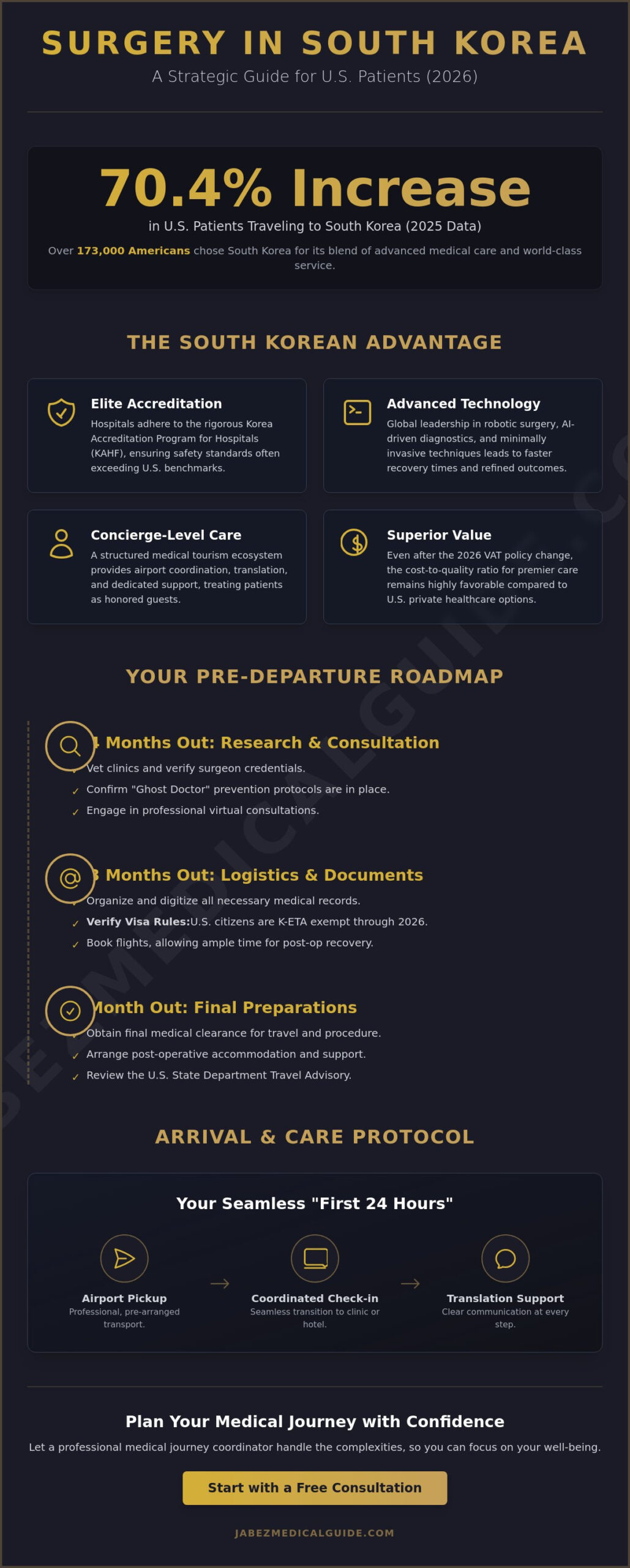
In 2025, more than 173,000 patients from the United States traveled to South Korea for medical care, marking a 70.4% increase from the previous year. This surge reflects a growing trust in Seoul’s medical infrastructure, yet the logistics of getting surgery in korea from usa can still feel like a daunting task. You likely have valid concerns about miscommunication during consultations, the physical toll of a long-haul flight after a procedure, or the nuances of 2026 visa regulations. It’s completely understandable to feel both hopeful and anxious when your well-being involves traveling halfway across the globe. You deserve a journey that’s as calm and organized as the results you’re expecting. This guide provides a professional, step-by-step roadmap to help you navigate every phase of your trip with absolute peace of mind. We’ll detail the recent 2026 tax policy changes, verify current visa exemptions for U.S. citizens, and help you build a realistic timeline for your surgery and recovery. By the end of this guide, you’ll have a clear strategy for a safe, high-end medical experience that prioritizes your comfort and care.
While South Korea remains a premier choice for surgical excellence, other regional hubs are also becoming highly regarded for specialized care; for example, VietClinics helps patients discover more about Dental Implants and restorative treatments in Vietnam with the same focus on safety and professional coordination.
Key Takeaways
- Understand how South Korean medical accreditation compares to U.S. standards to ensure your procedure meets the highest safety benchmarks.
- Establish a precise pre-departure timeline that includes digital medical record organization and professional virtual consultations.
- Navigate the specific logistical requirements for getting surgery in korea from usa, including 2026 medical visa updates and post-operative flight planning.
- Learn the “First 24 Hours” protocol for a seamless transition from the airport to your clinic with professional coordination and translation support.
- Identify the necessary recovery milestones and follow-up schedules required before safely boarding your return flight to the United States.
Why USA Patients are Choosing South Korea for Surgery in 2026
The decision to travel abroad for medical care is often driven by a search for excellence that feels out of reach at home. In 2026, the trend of getting surgery in korea from usa has evolved from a niche choice into a mainstream preference for those seeking refined results. This shift is supported by a medical infrastructure that blends technical mastery with a level of hospitality rarely seen in Western healthcare systems. Patients find that the journey offers a path to self-improvement that is both safe and meticulously organized.
Many patients initially worry about how qualifications abroad compare to U.S. standards. South Korean surgeons operate under the oversight of the Ministry of Health and Welfare, which enforces rigorous accreditation through the Korea Accreditation Program for Hospitals Serving Foreign Patients (KAHF). These standards ensure that clinics maintain high safety benchmarks and professional ethics. When getting surgery in korea from usa, you’re entering an ecosystem where government-approved medical tourism facilitators provide a protective layer of accountability. These specialists manage the complex logistics of your trip, ensuring that your experience is defined by clarity rather than confusion.
A significant differentiator in the Korean model is the presence of a dedicated support network. Medical Tourism in South Korea is structured around a concierge model that treats the patient as a valued guest. This approach includes services like medical visa assistance and coordinated airport pick-up and drop-off, which alleviate the stress of navigating a foreign country. By focusing on the human element of the journey, this system provides a steadying influence for those managing the uncertainty of international travel.
Advanced Technology and Surgical Specialization
South Korea’s medical leadership is built on a foundation of technological innovation. Clinics in Seoul are global leaders in minimally invasive techniques and robotic surgery, which often lead to shorter recovery times. The medical infrastructure heavily integrates AI and digital diagnostics to personalize every treatment plan. Because of the high volume of international patients, surgeons here often possess a deep specialization in specific procedures. This expertise leads to more predictable and refined surgical outcomes. Technical precision is a standard here.
The Economic Advantage for American Travelers
The value proposition for American patients remains strong in 2026. While the quality of care is world class, the cost-to-quality ratio is often more favorable than private healthcare options in the United States. It’s helpful to note that as of January 1, 2026, the 10% VAT refund for cosmetic procedures has been abolished. Despite this policy change, the total investment is still attractive due to current exchange rates and the comprehensive nature of Korean surgical packages. These packages often consolidate various recovery support services, making the financial planning of your trip straightforward and transparent. For a deeper understanding of how the 2026 “Medical Korea” initiative and KAHF certifications shape the patient experience, our medical tourism south korea patient guide provides a comprehensive overview of the regulatory landscape and what it means for your safety.
The Pre-Departure Phase: Planning Your Trip from the United States
Successful medical travel begins long before you arrive at Incheon International Airport. When getting surgery in korea from usa, a structured timeline is your most valuable asset. We recommend starting your planning at least three to four months in advance. This window allows you to vet clinics, secure medical clearance, and organize your recovery support without feeling rushed. A critical part of this vetting involves verifying that your chosen surgeon is the one actually performing the procedure. You should ask about “ghost doctor” prevention protocols, which ensure that the highly skilled expert you consulted with is the one in the operating room. Transparency in the surgical process is a non-negotiable standard for safety.
It’s vital to check the U.S. State Department Travel Advisory for South Korea for any current safety updates or entry requirements. While U.S. citizens currently benefit from a K-ETA exemption through the end of 2026, staying informed about official guidance provides an extra layer of security. If you feel overwhelmed by these logistical details, a professional medical journey coordinator can help you verify clinic credentials and organize every step of your pre-departure phase. Managing expectations is also key. You must understand what can realistically be achieved in a single trip, as some complex transformations may require staged procedures or longer healing times than a standard vacation allows.
Virtual Consultations and Medical Clearance
Virtual consultations are the bridge between your goals and reality. To prepare, you’ll need to provide clear, high-resolution photos from multiple angles and a comprehensive medical history. During your Zoom or WhatsApp call, focus on the surgeon’s specific experience with patients from the U.S. and their approach to your desired outcome. Before booking your flight, visit your primary care physician in the States to obtain a “fit to fly” clearance. This step is essential for your safety, especially considering the physiological impact of a 14-hour flight following a surgical procedure.
The 2026 Pre-Travel Checklist
Organization reduces anxiety. Ensure you have digital and physical copies of your prescriptions and medical records ready for your Korean medical team. You should also set up local communication tools like KakaoTalk and verify that your payment methods are accepted internationally without high foreign transaction fees. Most procedures require a stay of two to four weeks in Seoul to allow for initial healing and mandatory follow-up care. Planning for this duration ensures you aren’t rushing the “Golden Window” of recovery. Getting surgery in korea from usa is a significant commitment, and a well-prepared checklist is the first step toward a predictable, successful result.
Navigating Logistics: Visas, Flights, and Timing
The journey from the United States to South Korea is a significant physical undertaking, often involving 13 to 15 hours in the air. When you are getting surgery in korea from usa, your logistical planning must account for the physiological impact of this transit. Success isn’t just about the procedure itself; it’s about arriving in Seoul in the best possible physical condition to undergo anesthesia and surgery. Managing the transition from a U.S. time zone to Korea’s requires a methodical approach to prevent exhaustion from compromising your immune system.
A professional concierge plays a vital role in this transition. Instead of navigating the complex rail or bus systems at Incheon International Airport while jet-lagged, patients benefit from pre-arranged Airport Pick-up and Drop-off services. This ensures a seamless move from the terminal to your accommodation, allowing you to begin your rest immediately. Having a reliable navigator waiting for you at the gate provides a steadying influence that alleviates the initial stress of arrival in a foreign country.
The Medical Visa Process for US Citizens
In 2026, U.S. citizens continue to benefit from a temporary K-ETA exemption for stays under 90 days, which is currently extended through December 31, 2026. However, for more extensive procedures or longer recovery periods, the C-3-3 Medical Visa is often the more appropriate choice. A registered facilitator is essential here, as they provide the formal invitation letter required by the Korean consulate. Current processing times for U.S.-based applicants typically range from two to three weeks. You’ll need to provide proof of your scheduled procedure and financial stability to ensure a seamless entry. Our korea medical visa assistance services are designed to manage this documentation, so you don’t have to guess which forms are necessary.
Flight Strategies for Surgical Patients
Booking the right flight is a medical decision, not just a financial one. While it’s an additional investment, choosing “Premium Economy” or “Business Class” is highly recommended for the trans-Pacific leg. The ability to elevate your legs and have more space significantly reduces the risk of deep vein thrombosis (DVT), a critical concern for any long-haul traveler. Consider these strategic timing tips:
- The 48-Hour Buffer: Arrive in Seoul at least two full days before your first appointment. This allows your body to adjust to the 13 to 16-hour time difference and ensures you aren’t undergoing surgery while severely dehydrated or sleep-deprived.
- In-Flight Hydration: Drink significantly more water than usual and avoid caffeine or alcohol during the flight to maintain optimal skin and tissue health for your procedure.
- Movement Protocol: Wear compression socks and walk the cabin every two hours to maintain healthy circulation during the 13-15 hour flight from the U.S.
By treating your travel as the first phase of your medical treatment, you set a foundation for a safer procedure and a more comfortable recovery.
Your On-the-Ground Experience: Arrival and Procedure
The first 24 hours after arriving in Seoul are critical for setting a calm tone for your medical journey. When you are getting surgery in korea from usa, the transition from a long-haul flight to a clinical setting requires careful management. Your experience begins with a pre-arranged airport pick-up, where a coordinator meets you at the terminal. This service is designed to bypass the confusion of public transit, allowing you to settle into your accommodation and begin hydrating immediately. Most clinics schedule a final in-person consultation the day after arrival. This meeting is your opportunity to finalize the surgical plan while your body begins to adjust to the local time zone.
On the day of your procedure, the workflow is methodical and patient-centered. You’ll arrive at the clinic for pre-operative tests, which often include blood work and 3D imaging to confirm the surgical approach. A dedicated coordinator will guide you through the administrative process, ensuring you understand every document before signing. Following the procedure, you’ll be moved to a recovery suite where specialized staff monitor your initial vitals. Because 87.2% of foreign patients are treated in Seoul, the infrastructure here is highly optimized for international needs, providing a level of efficiency that helps reduce pre-surgical anxiety.
Effective Communication with Your Surgical Team
Clear communication is the foundation of a successful outcome. While many Korean doctors speak English, the nuances of medical terminology and aesthetic goals require a higher level of precision. Relying on basic mobile apps is insufficient for medical consent or explaining complex functional concerns. This is where the importance of professional medical translation becomes clear. A trained translator ensures that your surgeon understands your exact expectations and that you fully grasp the post-operative instructions. This partnership bridges the cultural gap, allowing you to move forward with confidence.
Hospital Stay and Immediate Post-Op Care
Recovery standards in South Korea often differ from those in the United States. Depending on the complexity of your procedure, you may experience a mix of in-patient and out-patient care. For major surgeries, an overnight stay in the hospital is common, providing you with professional supervision during the most sensitive hours. This environment focuses on pain management and early mobility, which are essential for preventing complications. For a broader look at what to expect, you can review our overview of plastic surgery in Korea. If you want to ensure your on-the-ground experience is managed with professional precision, consider engaging a dedicated surgery coordinator to handle your clinic logistics and arrival protocols.
Safe Recovery and the Journey Back to the USA
The final phase of your medical journey is just as critical as the procedure itself. Many patients feel a natural urge to return home as soon as they’re discharged, but rushing this transition can compromise your results. We refer to the first 7 to 14 days post-surgery as the “Golden Window” for recovery. This period is when the most significant healing occurs and when mandatory follow-up appointments, including stitch removal and wound care, must take place. Getting surgery in korea from usa requires a commitment to staying in Seoul until your surgical team officially clears you for long-haul travel.
Preparing for the return flight involves more than just packing your bags. You should arrange for wheelchair assistance at both Incheon International Airport and your arrival terminal in the United States. This service isn’t just about comfort; it’s a safety measure to prevent overexertion and minimize the risk of falls or accidental impact on surgical sites. Your recovery support services team will help you organize your post-operative medications and ensure you have all necessary documentation for customs, including a letter explaining any medical implants or prescriptions you’re carrying home.
Optimizing Your Recovery in Korea
One of the primary benefits of the Korean medical system is the access to specialized deswelling treatments. Most high-end clinics provide infrared light therapy, laser treatments, and hyperbaric oxygen chambers to accelerate tissue healing and reduce bruising. You can also support your body through nutrition. Local options like pumpkin porridge and specific botanical juices are traditionally used in Korea to aid in reducing post-surgical edema. It’s generally considered safe to board a 14-hour flight once your surgeon confirms that your incisions are stable and your risk of deep vein thrombosis has been mitigated through proper movement and medication.
Continuity of Care After Returning Home
The relationship with your surgical team shouldn’t end when you land back in the States. Continuity of care is essential for long-term monitoring and peace of mind. Jabez Medical Guide acts as a persistent bridge, facilitating ongoing communication between you and your Korean surgeon. If you have questions during your recovery in the U.S., we help manage these inquiries via telehealth or secure messaging to ensure you receive expert guidance quickly.
We also prioritize the documentation of your procedure. Before you depart, we ensure you have a comprehensive surgical report translated into English. This document is vital for your U.S. primary care physician’s records, allowing them to provide informed long-term care. Getting surgery in korea from usa is a life-changing decision, and our goal is to ensure that your transition back to your daily routine is as smooth and supported as your time in Seoul. If you’re ready to begin planning your recovery timeline, our Recovery Support Services are here to guide you through every step of the journey home.
Your Path to a Safe and Successful Medical Journey
A transformative medical experience depends on the strength of the logistical bridge you build before leaving home. You’ve learned that success involves more than selecting a surgeon; it requires a dedicated strategy for the “Golden Window” of recovery and a clear understanding of 2026 visa regulations. Getting surgery in korea from usa is a rewarding path when you have a reliable navigator to manage the complexities of international systems. Our partnerships with government-accredited hospitals and team of certified professional medical interpreters ensure that your safety and aesthetic goals are always the priority.
You don’t have to navigate this process alone. From korea medical visa assistance to end-to-end concierge support, we provide the steadying influence you need for a stress-free journey. We’re here to manage the details so you can focus entirely on your healing and results. Start your journey with a personalized consultation from Jabez Medical Guide and take the first step toward your destination with confidence. We look forward to being your partner in this exciting new chapter of your life.
Frequently Asked Questions
Is it safe to fly back to the USA immediately after surgery in Korea?
It is not safe to board a long-haul flight immediately following a surgical procedure. You should remain in Seoul for at least 7 to 14 days to allow your body to stabilize and to attend mandatory follow-up appointments. This window is essential for reducing the risk of deep vein thrombosis and ensuring your incisions are healing correctly before you endure the physical stress of a 14-hour trans-Pacific journey.
Do I need a special visa for medical treatment in South Korea?
U.S. citizens typically don’t need a specific medical visa for short-term treatments, as the K-ETA exemption for Americans is currently extended through December 31, 2026. This allows for stays up to 90 days for tourism or medical care. If your treatment plan requires a stay longer than three months, you’ll need to apply for a C-3-3 medical visa. We provide Medical Visa Assistance to help you secure the necessary documentation from your chosen clinic.
How do I handle follow-up care once I am back in the United States?
You can manage your long-term recovery by sharing a comprehensive, English-language surgical report with your U.S. primary care physician. We ensure you receive this documentation before you leave Korea so your local doctor understands the exact techniques used. For procedure-specific questions, we facilitate telehealth communication between you and your Korean surgical team to ensure continuity of care during your months of healing at home.
Will my Korean surgeon speak English, or do I need a translator?
Many surgeons in Seoul are proficient in English, but a professional medical interpreter is still a necessity for clinical precision. Using a certified translator ensures that subtle nuances regarding your aesthetic goals and medical history are perfectly understood during the consent process. We provide professional interpreters who specialize in medical terminology, providing you with the peace of mind that nothing is lost in translation during your consultations.
What happens if there is a complication after I return to the USA?
If you experience a minor concern, your first step is to contact your coordination team to arrange a virtual review with your surgeon in Korea. For urgent medical issues, you should visit a local U.S. healthcare provider immediately. Having your detailed surgical report ready allows American doctors to provide informed care based on your specific procedure, ensuring they have the facts needed to treat you safely and effectively.
How much time should I take off work for surgery in Korea?
Most patients should plan for a minimum of three to four weeks away from work when getting surgery in korea from usa. This timeline includes travel days, the procedure, and a 10 to 14-day recovery period in Seoul before your return flight. If your professional role involves physical activity, you might need to extend this period to ensure you don’t compromise your surgical results during the early stages of healing.
Can I travel to Korea for surgery alone, or should I bring a companion?
You can safely travel alone if you utilize professional recovery support services to manage your logistics and daily care. A dedicated coordinator provides a steadying influence, handling your airport transfers and clinic visits so you can focus on resting. While a companion offers emotional support, our concierge services are designed to fill the practical gaps, ensuring you’re never truly on your own during the recovery process.
How do I verify if a Korean plastic surgery clinic is legitimate?
You should verify a clinic’s legitimacy by confirming its registration with the Korean Ministry of Health and Welfare. Look for the KAHF (Korea Accreditation Program for Hospitals Serving Foreign Patients) certification, which is awarded to institutions that meet high safety and quality standards. We only coordinate with clinics that maintain these rigorous credentials, ensuring your procedure is performed in a verified, professional environment that prioritizes international patient safety. To learn more about how these certifications and the broader medical tourism south korea framework protect you as an international patient, our 2026 patient guide covers the full regulatory picture in detail.