

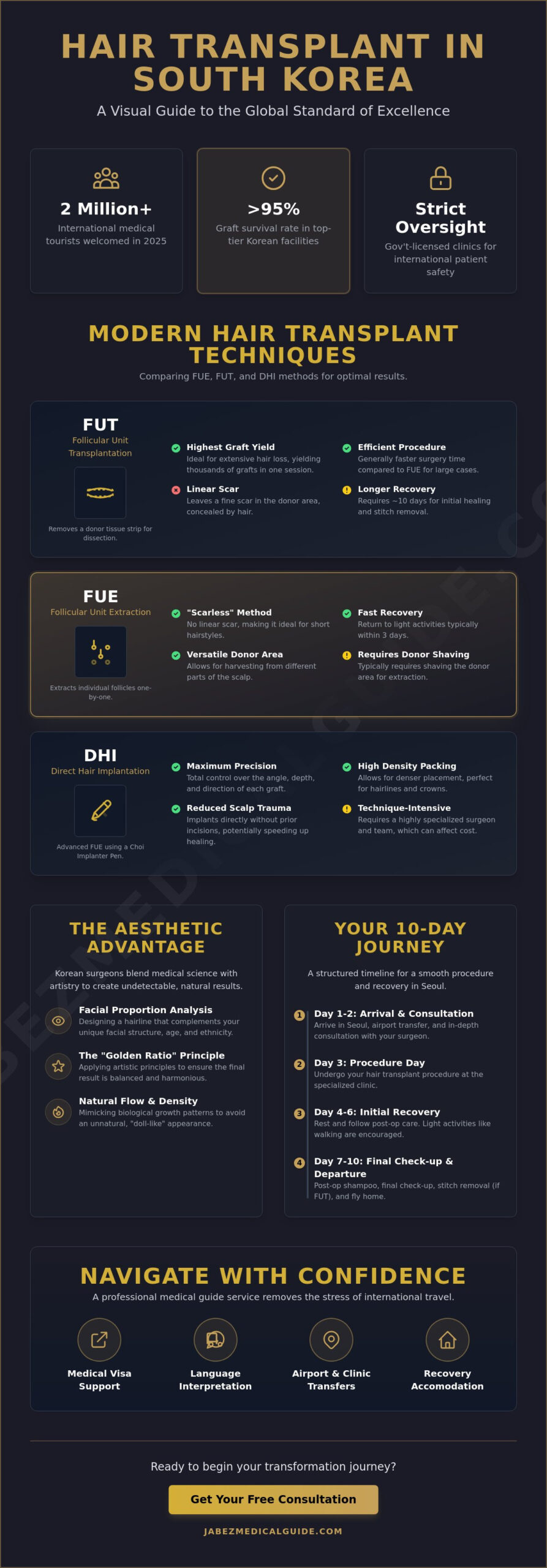
In 2025, South Korea welcomed over 2 million international medical tourists, a sharp rise that confirms its position as the world’s premier destination for specialized aesthetic care. If you’re researching a hair transplant in korea, you’re likely looking for more than just advanced technology. You want the artistic precision that avoids an unnatural, “doll-like” hairline. It’s common to feel a bit of tension when choosing between FUE and FUT methods or wondering how to manage a recovery period far from home.
We’ve created this handbook to give you the clarity and peace of mind you need for a successful transformation. You’ll learn why South Korean clinics are the global leaders in graft survival and how to navigate the local medical system with total confidence. We’ll preview the latest 2026 trends in DHI technology and explain how professional coordination turns a complex trip into a smooth, supportive experience. You can achieve a dense, natural-looking hairline through a process that feels organized and safe from start to finish.
Key Takeaways
- Compare FUE, FUT, and DHI methods to understand which technique offers the best density and recovery for your specific hair type.
- Discover how Korean surgeons use facial proportion analysis and the “Golden Ratio” to design a hairline that looks entirely natural.
- Follow a structured 10 day timeline for your hair transplant in korea to ensure you’ve allowed enough time for both the procedure and initial healing.
- Learn how a professional coordination service manages your medical visa, airport transfers, and recovery support to remove the stress of international travel.
- Identify the specific safety standards and government accreditations you should look for when selecting a specialized clinic in Seoul.
Why South Korea is the Global Capital for Hair Restoration
South Korea has established a reputation for excellence that goes beyond simple medical procedures. The “Korean Standard” focuses on high-density restoration and a natural flow that mimics biological growth patterns. While many destinations offer restoration, a hair transplant in korea is sought after because surgeons prioritize the aesthetic finish as much as the surgical success. This commitment to artistry ensures that the transition between existing hair and new grafts is virtually undetectable.
Success in this field is measured by graft survival rates. In top-tier Korean facilities, these rates often exceed 95% due to refined handling protocols and meticulous surgical environments. This level of quality is maintained through strict government oversight. The Ministry of Health and Welfare monitors all aesthetic institutions; it’s illegal for clinics to treat international patients without a specific medical tourism license. This regulatory framework provides a layer of safety and transparency that protects your health and your investment.
The Technology Behind the Success
Specialists here utilize high-magnification microscopic dissection to ensure that every follicle is harvested and prepared without damage. They also use specialized cold storage solutions to keep grafts viable while they’re outside the body. Before the procedure even begins, advanced scalp analysis tools help doctors determine the exact density required for a seamless look. You can read more about foundational concepts in Modern Hair Transplant Techniques: FUE, FUT, and DHI to understand how these methods have evolved into the sophisticated treatments available today.
Specialized Clinics vs. General Hospitals
You’ll find a high concentration of boutique clinics in Seoul that focus exclusively on hair restoration. These “hair-only” centers often provide superior results compared to general plastic surgery hospitals because their entire infrastructure is optimized for one goal. A key reason for their success is the presence of a dedicated graft-separating team. These technicians work in tandem with the surgeon to process follicles immediately after extraction. This synchronized teamwork leads to faster procedure times. It reduces patient fatigue and ensures the follicles spend as little time as possible outside the scalp, which is critical for long-term growth.
Choosing a specialized clinic means you’re benefiting from a high volume of specific experience. Surgeons in these environments perform the same delicate tasks every day, leading to a level of muscle memory and refined technique that’s hard to find elsewhere. When you combine this expertise with the logistical support of a coordination service, your journey becomes a well-organized path toward a confident new look.
Modern Hair Transplant Techniques: FUE, FUT, and DHI
Modern hair restoration in Seoul utilizes three primary surgical pathways. While FUE (Follicular Unit Extraction) has become the gold standard for many, FUT (Follicular Unit Transplantation) and DHI (Direct Hair Implantation) remain essential tools for achieving specific density goals. A successful hair transplant in korea depends on selecting the method that aligns with your hair loss pattern and scalp elasticity. Each technique has been refined by local specialists to minimize trauma to the scalp while maximizing the survival of every graft.
FUE is often called the “scarless” method because it involves extracting individual follicles rather than a strip of skin. This evolution in technique has made it the most popular choice for patients who prefer shorter haircuts or want to avoid a linear scar. DHI takes this a step further by using a specialized pen-like tool to implant grafts directly without creating pre-made incisions. This allows for extreme precision in angle and depth. It’s the preferred choice for high-density hairline work where the direction of hair growth is critical for a natural look.
FUE vs. FUT: Choosing Your Method
Recovery times vary significantly between these two approaches. FUE allows most patients to return to light activities within three days. FUT requires a longer healing period because it involves a linear incision that needs stitch removal after about ten days. Despite the longer recovery, FUT is often clinically superior for patients requiring a large number of grafts in a single session. It preserves the donor “bank” more efficiently for some, as it leaves the surrounding follicles untouched for future use. When considering the fue hair transplant korea price, remember that FUE typically costs more because it is more labor-intensive for the surgical team. Research from The Korean Advantage: Aesthetic Artistry and Hairline Design highlights that patient selection is the most critical factor in determining which method will yield the best long-term outcome.
Non-Shaven FUE: The “Secret” Procedure
For professionals who cannot afford visible signs of surgery, the “No-Cut” or “Long Hair” FUE technique is a significant advancement. This method allows the surgeon to extract and transplant follicles without shaving the donor or recipient areas. It’s technically demanding and requires a high level of expertise, which is why it’s primarily offered at elite clinics. You can return to work almost immediately without anyone knowing you’ve had a procedure. If you’re unsure which technique fits your lifestyle, our team at Jabez Medical Guide can help you understand the specific requirements for these advanced options. Choosing the right method is the first step toward a seamless and stress-free recovery.
The Korean Advantage: Aesthetic Artistry and Hairline Design
Korean surgeons have transformed the perception of hair restoration by treating the procedure as a form of portraiture. A successful hair transplant in korea isn’t just about moving follicles from one place to another; it’s about the meticulous reconstruction of a frame for the face. The goal is to move beyond the “pluggy” or “doll-like” hairlines associated with older techniques. Instead, doctors focus on micro-irregularities. These mimic the way hair naturally grows in staggered, non-linear patterns. By varying the angle and direction of each graft, they ensure the results are indistinguishable from your original hair.
This precision starts with facial proportion analysis. Surgeons use the “Golden Ratio” to divide the face into horizontal thirds, ensuring the new hairline aligns perfectly with the forehead, nose, and chin. By analyzing your unique bone structure, they determine the most flattering height and width for your hairline. They don’t just look at where hair used to be. They look at how a new hairline will age with you over the next twenty years. This forward-thinking design prevents a result that looks out of place as you mature.
Hairline Design for Men vs. Women
Design principles vary significantly based on gender and individual goals. For men, the focus is often on restoring density and reinforcing the temple angles to create a strong, masculine profile. Surgeons are careful not to make the line too straight, as a slightly recessed temple often looks more natural as a man ages. For women, the priority is usually forehead reduction and creating soft, rounded contours. This often involves using the finest “baby hairs” at the very front to ensure a delicate transition. Korean clinics also specialize in customizing these designs based on ethnic hair characteristics, such as thickness and curl, to ensure the grafts blend seamlessly with existing strands.
The Role of the Trichologist and Surgeon Team
The best results come from a collaborative environment. While the lead surgeon handles the design and critical incisions, a specialized technical team manages the delicate handling of grafts. This team-based approach ensures that every follicle is treated with the highest level of care. Post-operative care for a hair transplant in korea typically includes laser therapy and PRP (Platelet-Rich Plasma) treatments to stimulate the scalp and improve graft survival. Total facial harmony often involves looking at the face as a whole. It’s why plastic surgery in korea often integrates hair restoration to balance features and achieve a more youthful appearance. This holistic view ensures that your new hairline complements your entire facial structure.
Planning Your Medical Journey: Logistics and Recovery
Successful planning for a hair transplant in korea requires a structured approach to your travel and healing. Most patients should allocate a 7-to-10 day window for their trip. This timeline allows for a day of rest before the procedure and several days of essential post-operative monitoring afterward. Before you depart, you’ll need to complete virtual consultations and share recent blood test results. Your coordination team will also guide you through medication adjustments; this usually involves pausing certain supplements or medications that can affect surgical outcomes.
Logistics are the foundation of a stress-free experience. Managing medical visas, airport transfers, and local accommodation can feel overwhelming without professional support. We recommend staying in the Gangnam or Seocho districts to remain close to the specialized clinics. This proximity reduces travel fatigue during the sensitive first few days of recovery. Having a dedicated driver for airport pick-up and drop-off ensures you won’t have to navigate public transit while you’re in the initial stages of healing.
The First 72 Hours: Critical Post-Op Care
The initial three days after surgery are the most vital for graft survival. You must protect the newly implanted follicles from any friction or pressure. One of the most important rules is that the first hair wash must be done by the clinic staff. They use specialized techniques to cleanse the area without dislodging the grafts. Managing swelling is also a priority during this phase. Clinics often provide cooling packs and specific sleeping instructions to keep your head elevated. For those who want an extra layer of safety, utilizing post-op care services in korea can provide the professional oversight needed during this delicate period.
Long-Distance Follow-Up and Results
Recovery is a marathon, not a sprint. After you return home, you’ll enter the “scabbing” phase, followed by the “shedding” or “shock loss” phase within the first month. This shedding is a normal part of the hair cycle; the follicles remain healthy beneath the skin. Full growth and density typically appear around the 12-month mark. Most international patients manage their follow-ups through tele-medicine, sending high-resolution photos to their surgeon for review. If you’re ready to start organizing these details, the team at Jabez Medical Guide is here to handle the logistics so you can focus entirely on your recovery.
Navigating Your Treatment with a Professional Medical Guide
Booking a hair transplant in korea directly often seems like a cost-saving measure, but it introduces hidden complexities. Language barriers are the most immediate hurdle. During a surgical consultation, nuance matters. Misinterpreting a surgeon’s advice on graft placement or density can lead to results that don’t match your expectations. A professional guide acts as your advocate; they ensure that every detail of your aesthetic vision is perfectly translated into a clinical plan. This advocacy also protects you from “foreigner pricing” traps, where international patients are sometimes quoted significantly higher rates than local residents.
Beyond communication, a coordination service transforms a stressful medical trip into a curated, luxury experience. This bridge between a foreign healthcare system and your personal comfort is what separates a standard procedure from a successful journey. You aren’t just a patient. You’re a guest in a system that values hospitality as much as technical skill. Having a steady navigator to manage your logistics allows you to focus entirely on your healing and the exciting results ahead.
Safety and Transparency in Korean Healthcare
The regulatory environment for medical tourism in south korea is designed to protect you. All clinics treating international patients must hold a specific medical tourism license issued by the Ministry of Health and Welfare. The Jabez commitment involves a rigorous vetting process. We only partner with surgeons who demonstrate consistent results and adhere to the highest ethical standards. Transparency is our priority. We ensure you receive a clear breakdown of costs with no hidden hospital fees or surprise charges. We also help you navigate the VAT refund process, ensuring you receive the tax benefits available to non-Korean citizens upon your departure.
Your Next Steps: The Virtual Consultation
Your journey begins with a personalized graft estimate. This virtual step is essential for setting realistic expectations and determining the scope of your hair transplant in korea. By sharing high-resolution photos of your donor and recipient areas, you can receive a professional assessment before you even book a flight. This early interaction provides the clarity you need to plan your time and budget effectively. If you’re ready to move forward with a partner who values organization and meticulous attention to detail, you can consult with Jabez Medical Guide for your personalized hair restoration plan. We’ll act as your service-oriented partner, ensuring every phase of your transformation is handled with quiet confidence and care.
Take the Next Step Toward Lasting Confidence
Choosing a hair transplant in korea is a significant decision that combines world-class surgical technology with meticulous aesthetic design. You’ve seen how the “Korean Standard” prioritizes graft survival and natural-looking hairlines through techniques like DHI and FUE. Success depends on more than just the surgery; it’s built on careful planning, clear communication, and professional post-operative support. By partnering with a dedicated coordinator, you remove the uncertainty of navigating a foreign medical system alone.
At Jabez Medical Guide, we act as your reliable navigator throughout this transformation. We maintain active partnerships with government-accredited medical institutions to ensure your safety and results. Our team provides certified medical translators for absolute communication clarity during your design phase, along with 24/7 concierge support to manage every detail of your stay. You don’t have to manage the complexities of international travel and recovery by yourself. Begin your transformation with a professional hair restoration consultation today. We look forward to supporting you as you achieve the dense, natural results you deserve.
Frequently Asked Questions
Is a hair transplant in Korea worth the travel from the USA?
Traveling for a hair transplant in korea is often worth the effort because patients gain access to some of the world’s most specialized surgeons and advanced technology. While costs are generally more competitive than in the United States, the primary value lies in the technical excellence and aesthetic artistry available in Seoul. You receive a level of care that prioritizes natural results and long-term hair health through highly refined procedures.
How much does a 3,000 graft hair transplant cost in Korea in 2026?
The cost for a 3,000 graft procedure in 2026 depends heavily on the technique you choose, such as FUE or DHI. FUE is typically more labor-intensive and carries a different price point than the FUT method. Prices also vary based on the clinic’s location and the surgeon’s experience level. For an accurate figure, it’s best to request a personalized estimate that includes your specific graft requirements and potential VAT refunds.
How long do I need to stay in Korea after the surgery?
A stay of 7 to 10 days is the recommended standard for international patients. This timeline is necessary to accommodate the initial post-operative checkups and the essential first hair wash performed by the clinic’s technical team. Leaving too early can increase the risk of complications, so allowing a full week ensures your grafts are stable enough for the journey home and that initial healing is on track.
Can I fly immediately after a hair transplant procedure?
You shouldn’t fly immediately after your procedure; it’s best to wait at least three days. Cabin pressure changes and the physical strain of navigating airports can exacerbate swelling and potentially dislodge new grafts. Waiting until the initial healing phase is complete ensures that your results aren’t compromised by the environmental stresses of a long-haul flight. Most surgeons advise waiting for a final scalp check before departure.
Will I need a special visa for a hair transplant in Korea?
Many visitors use a standard tourist visa, but a C-3-3 medical visa is the official pathway for healthcare travelers. The requirements for a hair transplant in korea vary based on your home country and the intended length of your stay. A coordination service can provide medical visa assistance to help you navigate the application process and ensure all your documentation is in order before you arrive for treatment.
What is the success rate of hair transplants at Korean clinics?
Graft survival rates at leading Korean facilities often exceed 95% due to meticulous handling and preservation protocols. This is achieved through the use of specialized teams who focus exclusively on follicle separation and preparation. This high level of technical precision is a hallmark of the industry in Seoul, ensuring that nearly every transplanted hair takes root successfully and grows in a direction that mimics your natural hair flow.
How do I know if the surgeon I choose is accredited?
You can confirm a surgeon’s credentials by verifying their clinic’s license with the Ministry of Health and Welfare. In South Korea, it’s a legal requirement for any facility treating international patients to hold a specific medical tourism certification. A professional navigator can help you cross-reference these licenses to ensure you’re paired with a government-accredited specialist who meets strict standards for safety, hygiene, and clinical performance.
Is the hair transplant result permanent?
Hair transplant results are considered permanent because the follicles are taken from areas of the scalp that aren’t affected by male pattern baldness. These donor hairs retain their resistance to thinning even after they are moved to the hairline. While the transplanted hair is lifelong, it’s important to manage any ongoing natural hair loss in other areas. Following a long-term scalp care plan helps you maintain consistent density across your entire head.