

You might assume a massive medical center is always the safest bet for your transformation, but for specific aesthetic goals, the intimacy of a boutique setting often yields superior precision. It’s natural to feel overwhelmed when weighing the safety of a large institution against the specialized artistry of a private surgeon, especially since the 2026 removal of the 10% VAT refund makes your financial planning more critical than ever. Deciding between a korean hospital vs private clinic plastic surgery requires a clear understanding of how facility scale impacts your specific procedure and recovery.
We understand that your peace of mind depends on knowing exactly who is behind the mask and what emergency protocols are in place. This guide clarifies the critical differences in safety standards, specialization, and expected results to help you make a confident choice for your journey. We’ll examine how mandatory surgery room CCTV laws now protect you from “shadow doctors” and explain why a facility’s focus often dictates the final aesthetic outcome. You’ll gain a clear perspective on which environment aligns with your risk profile and aesthetic goals, ensuring a vetted path to a high-quality surgeon.
Key Takeaways
- Understand the legal distinctions under the Korean Medical Service Act to differentiate between outpatient-focused clinics and full-scale hospitals.
- Evaluate the safety advantages of large institutions, including on-site emergency response teams and multi-specialty support for complex cases.
- Discover the benefits of specialized “Boutique” clinics where a single expert surgeon prioritizes artistic precision and personalized care.
- Apply a clear decision matrix to determine if your procedure requires the infrastructure of a korean hospital vs private clinic plastic surgery for optimal results.
- Learn how a professional coordination partner navigates the vetting process to connect you with institutions that meet rigorous safety and quality standards.
The Korean Medical Hierarchy: Defining Hospitals vs. Private Clinics
The distinction between a medical facility’s size and its legal classification is a critical detail that many international patients overlook. In South Korea, the healthcare system is governed by the Korean Medical Service Act, which creates a rigid hierarchy based on bed capacity, staffing, and departmental diversity. Choosing between a korean hospital vs private clinic plastic surgery isn’t just about the building’s aesthetic. It’s about understanding the regulatory safety net that supports your procedure.
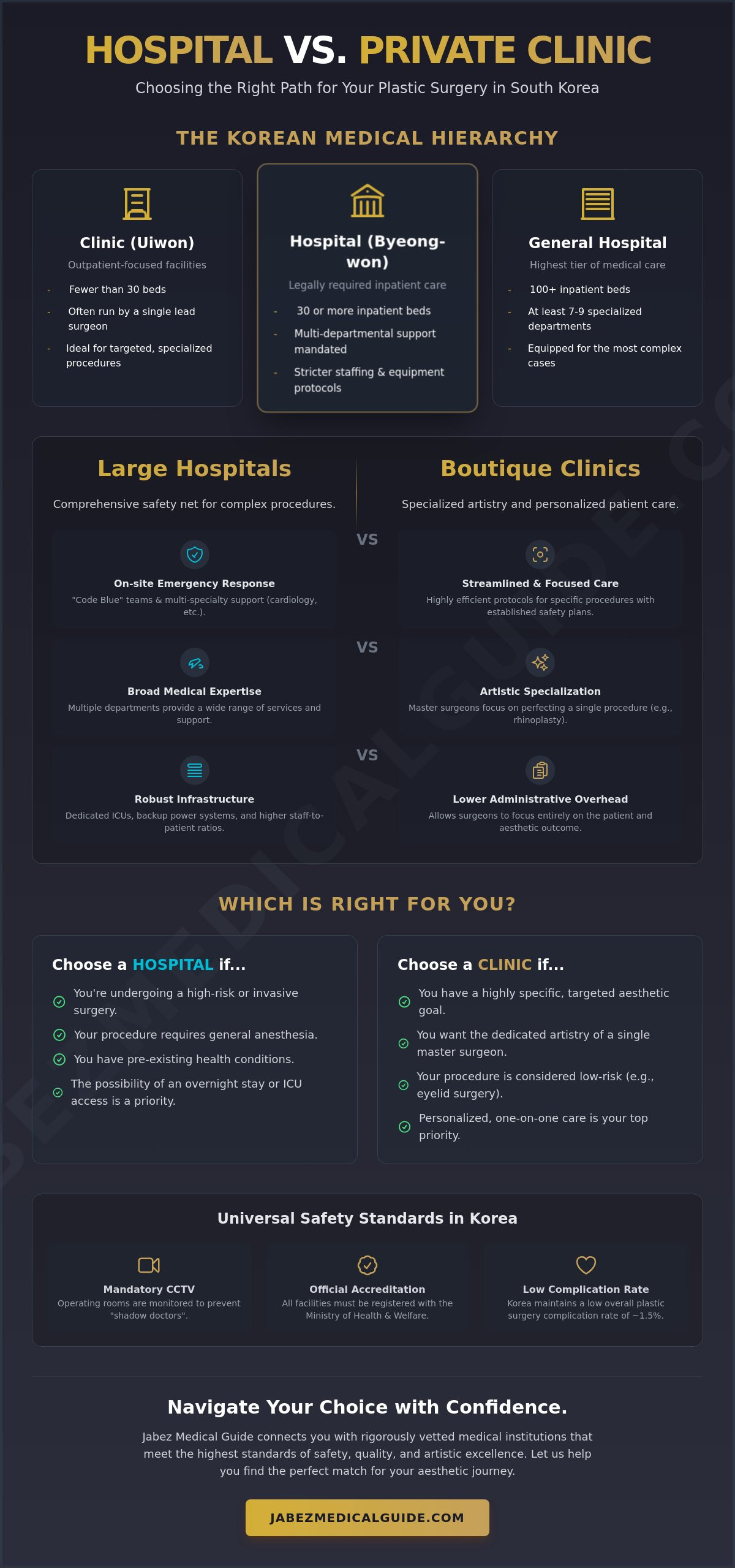
Under Korean law, a “Clinic” (Uiwon) is primarily designed for outpatient care. These facilities typically maintain fewer than 30 beds and are often owned and operated by a single lead surgeon. In contrast, a “Hospital” (Byeong-won) is legally required to have 30 or more inpatient beds and must provide multi-departmental support. The highest tier, the “General Hospital,” must maintain at least 100 beds and host between 7 and 9 specialized departments, such as internal medicine, general surgery, and anesthesiology. This hierarchy ensures that larger institutions have the breadth of expertise to handle complex medical scenarios.
The Legal Requirements for Korean Medical Institutions
The staffing and equipment mandates for these tiers vary significantly. Hospitals are required to have a higher ratio of medical professionals to patients and must maintain specific emergency infrastructure. This includes dedicated intensive care unit (ICU) access and sophisticated backup power systems to ensure patient safety during unforeseen events. While clinics are highly efficient for targeted procedures, hospitals must follow stricter protocols for on-site anesthesiologists. Every institution, regardless of size, must be registered with the Ministry of Health and Welfare to legally treat foreign patients. This accreditation is your first line of defense, ensuring the facility meets baseline national standards for hygiene and care.
Why the Name Matters for Your Surgical Safety
A facility’s formal designation implies a specific level of government oversight. The “Hospital” label carries a heavier burden of regulatory compliance, which often translates to more robust safety protocols for high-risk surgeries. However, the Cosmetic surgery in South Korea market is unique because many world-class surgeons prefer the “Clinic” model. This boutique approach allows a specialist to focus entirely on one type of refinement, such as rhinoplasty or eyelid surgery, without the administrative weight of a large institution.
Understanding these nuances is the first step in our methodical approach to patient care. We help you weigh the comprehensive safety of a large institution against the specialized artistry found in boutique settings. For a deeper look at how the national system supports international visitors, you can explore our Medical Tourism in South Korea: The 2026 Patient Guide to World-Class Care. This context is vital when deciding if your specific goals require the infrastructure of a massive medical center or the precision of a private specialist.
Safety and Emergency Infrastructure: The Case for Large-Scale Hospitals
Safety is the cornerstone of any successful surgical outcome. While the overall complication rate for plastic surgery in Korea is a low 1.5% according to the Ministry of Food and Drug Safety, major procedures still carry inherent risks. Large-scale hospitals provide a comprehensive safety net that smaller facilities often can’t match. This infrastructure is a primary factor when evaluating a korean hospital vs private clinic plastic surgery for invasive operations. These institutions operate with “Code Blue” protocols, ensuring that an emergency response team is always on standby to handle rare but serious complications.
The presence of multiple specialists under one roof is a significant advantage. If a patient experiences an unexpected reaction, a cardiologist or pulmonologist is available within minutes. This multi-disciplinary approach is especially vital for surgeries requiring general anesthesia. In a large hospital, a dedicated, resident anesthesiologist remains in the operating room from the first incision to the final stitch. They don’t just “start” the anesthesia; they manage your vitals in real-time, providing a level of vigilance that is essential for long procedures.
High-risk patients or those undergoing extensive transformations also benefit from on-site Intensive Care Units (ICU). Having immediate access to advanced life-support systems prevents the need for risky emergency transfers to other facilities. If you feel uncertain about which level of care your procedure requires, our team at Jabez Medical Guide can help you evaluate the safety protocols of specific institutions.
Advanced Reconstructive Capabilities
Procedures involving bone-cutting, such as jaw or facial contouring, require extreme precision and high-end imaging. Large hospitals typically house their own CT and MRI suites, allowing surgeons to verify results immediately after the operation. These centers also maintain rigorous sterilization standards that mirror those of general medical hospitals, reducing the risk of post-operative infections. The scale of these facilities allows for specialized hygiene teams whose sole job is to maintain a sterile surgical environment.
Managing Pre-existing Medical Conditions
Patients with chronic conditions like diabetes or heart issues face unique challenges during surgery. A multi-departmental hospital can perform comprehensive pre-operative screenings to ensure you’re fit for the procedure. This thorough vetting process minimizes surprises on the day of surgery. For those traveling from abroad, our Getting Surgery in Korea from the USA: The Complete 2026 Planning Guide provides specific advice on coordinating your medical history with Korean specialists to ensure a safe and seamless experience.
Artistic Precision and Specialization: Why Many Choose Private Clinics
While large hospitals offer the security of a multi-departmental safety net, many patients seeking aesthetic refinement gravitate toward the “Boutique” philosophy of private clinics. These smaller institutions prioritize a highly personalized experience, often focusing on the expertise of a single master surgeon. When comparing a korean hospital vs private clinic plastic surgery, the clinic model is frequently synonymous with artistic precision and a dedication to specific, natural-looking results.
The “Factory System” occasionally seen in massive hospitals can feel impersonal, with patients moving through a high-volume assembly line. Private clinics contrast this by offering a “one surgeon, one patient” approach. This structure is particularly effective at mitigating the “Shadow Doctor” concern, a practice where an un-credentialed or less experienced doctor performs the surgery instead of the famous surgeon you booked. In a boutique clinic, the lead surgeon’s reputation is the brand’s primary asset. This transparency is further bolstered by the 2023 law requiring surgery room CCTV, which is now a standard and established practice in 2026. This allows you to verify that your chosen expert is indeed the one performing your procedure.
The Master Surgeon Model
Top Korean surgeons often leave large institutions to open private clinics where they can focus exclusively on a single specialty, such as rhinoplasty or facial contouring. This high degree of specialization contributes to better outcomes and lower complication rates, as the surgeon may have performed thousands of one specific procedure. These settings also boast a higher ratio of nursing staff to patients, ensuring that you receive attentive, individualized care. Most importantly, your initial consultation in a clinic is almost always with the actual surgeon, allowing for a direct exchange of aesthetic goals and surgical possibilities.
Post-Operative Care and Privacy
Recovery in a private clinic is designed around comfort and discretion. Instead of a busy hospital ward, patients often rest in quiet, private recovery lounges that feel more like a high-end spa than a medical facility. Many clinics now utilize specialized recovery technologies to accelerate healing, such as HEALITE II light therapy or hyperbaric oxygen chambers. These tools are specifically chosen to minimize swelling and downtime, which is essential for international travelers. For a detailed look at how to manage your healing process, our Post-Op Care Services in Korea: The 2026 Guide to Safe Recovery provides a comprehensive roadmap for your journey home.
Decision Matrix: Matching Your Procedure to the Right Facility Type
Selecting the right environment for your surgery shouldn’t be a matter of luck. It’s a strategic decision based on your physical health and the technical demands of your transformation. While we’ve discussed the safety of hospitals and the artistry of clinics, the final choice depends on where your specific procedure sits on the risk spectrum. Deciding between a korean hospital vs private clinic plastic surgery requires a clear-eyed look at the complexity of your goals.
We define surgical risk as a combination of the anesthesia type and the total duration of the procedure. Any operation lasting longer than four hours or requiring aggressive bone manipulation naturally leans toward a hospital setting. Conversely, shorter, more localized refinements thrive in the specialized atmosphere of a clinic. If you’re unsure which category your surgery falls into, our plastic surgery coordination team can provide a personalized assessment of the facility types best suited for your needs.
Procedure Complexity Guide
- Procedures demanding a Hospital: Two-jaw surgery (Orthognathic), body contouring for patients with a high BMI, and complex secondary revisions that require long hours under general anesthesia.
- Procedures ideal for a Clinic: Upper or lower eyelid surgery, primary rhinoplasty, and anti-aging dermatology treatments. These rely on the surgeon’s repetitive mastery of a single aesthetic focus.
There’s also a “Hybrid” model gaining popularity in 2026. Many specialized clinics are now located within larger medical complexes in districts like Gangnam. This allows you to enjoy the boutique experience of a master surgeon while having the peace of mind that the building itself houses comprehensive emergency facilities.
Facility Vetting Checklist
Regardless of the size of the facility, certain benchmarks for quality are non-negotiable. Before you commit to a deposit, verify that the institution meets these three critical standards:
- KAHF Status: Confirm the “Korean Accreditation Program for Hospitals Serving Foreign Patients” certification. This indicates the facility has been audited for its ability to care for international visitors.
- KSPRS Certification: Verify that your surgeon is board-certified by the Korean Society of Plastic and Reconstructive Surgeons. This ensures they’ve completed the rigorous training required in this competitive field.
- Emergency Monitoring: Check for a 24-hour monitoring system and the presence of a resident anesthesiologist, especially if you’re undergoing general anesthesia.
Ensuring Quality: How Jabez Medical Guide Vets Korean Medical Institutions
Choosing between a korean hospital vs private clinic plastic surgery involves more than just comparing facility sizes or looking at social media portfolios. It requires an intimate understanding of the Korean healthcare system’s internal workings. We act as your professional navigator, bridging the gap between international patients and the complex medical landscape of Seoul. Our role is to ensure that your path to transformation is built on a foundation of verified safety and specialized expertise.
Our partnership criteria go far beyond basic government registration. We conduct rigorous, ongoing evaluations of every institution we recommend, focusing on clinical precision and patient safety protocols. A critical part of this vetting process involves ensuring that professional medical translation is always available. Miscommunication during a surgical consultation can lead to irreversible errors; therefore, we prioritize facilities that value clear, technical communication as much as they value aesthetic results. From managing your initial coordination to arranging recovery support services, we provide a steady influence throughout your journey.
Beyond the Marketing: Real-World Vetting
We believe that real-world outcomes speak louder than high-budget marketing campaigns. Our team actively monitors local reports and patient feedback to identify any concerns regarding “shadow doctors” or declining safety standards. Having a local advocate who understands the nuances of Korean medical law provides you with a layer of protection that automated review platforms cannot offer. We also simplify the logistical hurdles of international travel, providing comprehensive Korea Medical Visa Assistance: A Complete How-To Guide for 2026 to ensure your entry into the country is as smooth as your procedure.
Your Personalized Surgical Journey
Every patient has a unique aesthetic vision that requires a specific surgical touch. We don’t just match you to a facility based on its size; we match you to a surgeon whose specialization aligns with your specific goals. Whether you require the robust infrastructure of a multi-departmental hospital or the artistic focus of a boutique clinic, our recommendations are tailored to your risk profile and desired outcome.
Our support extends well beyond the operating room. We coordinate airport pick-up and drop-off, manage your dermatology or hair restoration treatments, and provide dedicated recovery support services to ease your healing process. This high-end concierge approach is designed to reduce anxiety, allowing you to focus entirely on your recovery. If you’re ready to take the next step with a partner who values transparency and meticulous detail, consult with a Jabez Medical Navigator today to begin your journey with confidence.
Your Path to a Safe and Successful Transformation
Choosing the right surgical environment is the most significant decision you’ll make on your aesthetic journey. Whether your goals require the robust infrastructure of a korean hospital vs private clinic plastic surgery or the boutique focus of a private specialist, your safety remains the highest priority. You now understand how procedure complexity dictates the necessary facility scale and why verifying credentials like KAHF accreditation is essential in 2026. This knowledge empowers you to move beyond marketing claims and focus on verified medical standards.
We’re here to act as your dedicated navigator through every step of this process. We partner exclusively with government-accredited institutions and provide certified medical interpreters for every consultation to ensure absolute clarity. With our 24/7 on-the-ground support in South Korea, you’ll never have to navigate the medical system alone. Let Jabez Medical Guide help you find the perfect hospital or clinic for your needs. Your journey toward a more confident version of yourself deserves a partner who values meticulous detail and your ultimate peace of mind.
Frequently Asked Questions
Is a general hospital always safer than a private clinic in Korea?
Safety depends primarily on the complexity of your procedure and your personal health history. While general hospitals offer the security of multi-departmental support for high-risk cases, a specialized clinic may have a lower complication rate for specific aesthetic refinements. Your choice between a korean hospital vs private clinic plastic surgery should be based on whether you need intensive care infrastructure or specialized artistic precision.
How can I tell if a private clinic is properly licensed for international patients?
You can verify a facility’s legal status by checking its registration with the Ministry of Health and Welfare. It’s also advisable to look for the “Korean Accreditation Program for Hospitals Serving Foreign Patients” (KAHF) certification. This accreditation confirms that the institution meets rigorous national standards for safety, hygiene, and the specific needs of travelers from abroad.
What are shadow doctors, and are they more common in hospitals or clinics?
Shadow doctors are un-credentialed practitioners who perform surgery in place of the surgeon you actually booked. While this practice was historically associated with high-volume hospitals, the mandatory surgery room CCTV law is now a standard tool for protection. You have the legal right to request a recording of your procedure to ensure your chosen expert performed the entire operation.
Do private clinics in Korea have emergency equipment like defibrillators?
Yes, all licensed surgical clinics are required by law to maintain essential emergency equipment. This includes defibrillators, advanced monitoring systems, and oxygen tanks. Reputable clinics also invest in uninterruptible power supplies (UPS) to ensure that life-support and surgical equipment continue to function even during an unexpected power failure.
Will my surgery be cheaper at a private clinic compared to a general hospital?
Facility size doesn’t always dictate the final cost of your procedure. While large hospitals have significant administrative overhead, many “master surgeons” in private clinics charge premium rates for their specialized expertise. In 2026, you should also account for the elimination of the 10% VAT refund for cosmetic procedures when planning your total surgical budget.
Can a private clinic handle general anesthesia safely?
Private clinics can administer general anesthesia safely provided they employ a resident anesthesiologist. It’s critical to confirm that a dedicated specialist will be present in the operating room to monitor your vitals for the entire duration of the surgery. This level of one-on-one vigilance is a hallmark of high-quality boutique medical care.
Which facility type is better for a “natural” Korean plastic surgery look?
Many patients find that private clinics are better suited for achieving the “natural” aesthetic trends of 2026. Surgeons in these settings often focus exclusively on one or two types of procedures, such as rhinoplasty or eyelid surgery. This high degree of specialization allows them to master the subtle, artistic nuances required for results that don’t look “operated on.”
What happens if a complication occurs at a private clinic?
Clinics follow established emergency protocols to ensure patient safety in the event of a complication. If a situation requires intensive care beyond the clinic’s capabilities, the staff will stabilize the patient and initiate an immediate transfer. Most reputable clinics maintain formal agreements with nearby general hospitals to ensure a seamless transition to advanced medical support if needed.