

What if a simple paperwork error forced you to cancel your surgical transformation just 48 hours before your flight? Professional korea medical visa assistance acts as your legal safeguard, ensuring your recovery journey starts without a single immigration hurdle. It’s natural to feel overwhelmed by the choice between a K-ETA and a C-3-3 medical visa, especially when government forms feel like a language barrier you can’t quite climb. You’ve likely spent months researching the right clinic; the last thing you want is for a technicality to ruin your schedule.
This guide provides a clear roadmap to securing your South Korean medical visa with expert support. You’ll gain the confidence that every document is compliant and ready for approval. We will walk you through the 2026 application requirements, current processing timelines, and exactly how a dedicated facilitator manages the logistics so you can focus entirely on your upcoming procedure.
Key Takeaways
- Identify the specific requirements of the C-3-3 Medical Visa and the essential documents you need from accredited Korean hospitals to avoid application rejection.
- Discover how professional korea medical visa assistance prevents common administrative errors and manages the critical communication between your clinic and the consulate.
- Gain a clear, chronological roadmap of the application journey, detailing exactly what to expect from the initial inquiry through to final visa approval.
- Learn how a dedicated facilitator acts as a reliable navigator, streamlining your entry into South Korea so you can focus entirely on your recovery and care.
Understanding the South Korean Medical Visa (C-3-3) in 2026
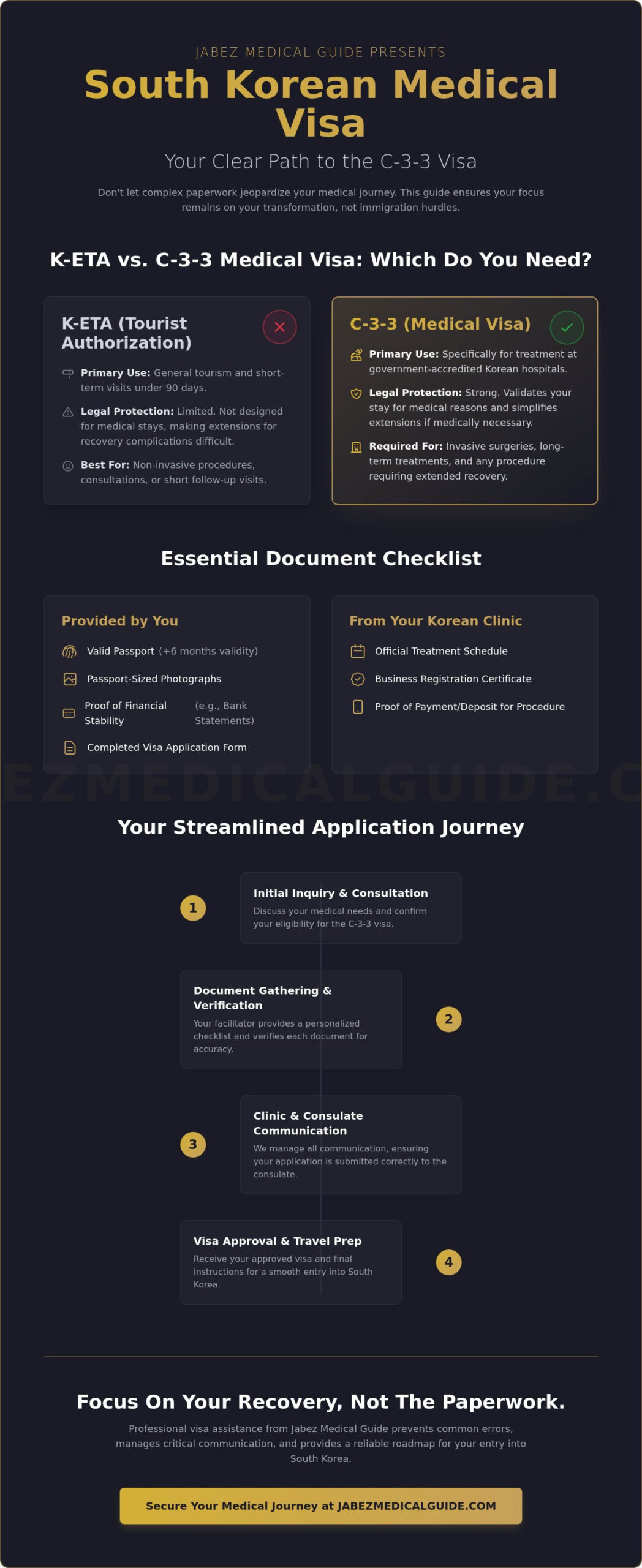
The C-3-3 Medical Visa is a specialized entry permit designed specifically for international patients. Unlike standard tourist entries, this visa requires you to seek treatment at hospitals accredited by the Korean government. While there are many South Korean visa types, the C-3-3 is the primary choice for individuals traveling for surgery or advanced dermatological care. It’s a legal safeguard that validates your stay for medical purposes. For patients requiring long-term treatment or extended recuperation exceeding 90 days, the G-1-10 visa serves as an alternative, though most elective procedures fall under the C-3-3 category.
Professional korea medical visa assistance helps you determine which path is right for your specific health goals. This clarity is essential because entering on the wrong status can lead to complications if you need to extend your stay for medical reasons. Securing the correct visa ensures your focus remains on healing rather than administrative hurdles. It provides a level of security that standard tourist authorizations simply cannot match.
K-ETA vs. Medical Visa: Which One Do You Need?
Choosing between a K-ETA and a C-3-3 Medical Visa depends on your procedure type and recovery needs. The K-ETA is a convenient option for short-term visits under 90 days, but it’s fundamentally a tourist authorization. It doesn’t offer the same legal protections as a dedicated medical visa. If you’re undergoing invasive surgeries that require careful monitoring, the C-3-3 is preferred. It provides an official medical status while you’re in-country, making it much easier to request extensions if your physician recommends a longer stay for safety. You don’t want to worry about visa expiration while you’re still in bandages.
The Role of Government-Approved Medical Facilitators
A registered facilitator acts as your official inviter under Korean law. These agencies must undergo a rigorous verification process with the government to earn the right to assist international patients. Expert korea medical visa assistance ensures that these agencies handle the heavy lifting of document verification and hospital communication. They act as a bridge between you and the Korean consulate, ensuring that your application is accurate and compliant. Using a verified facilitator reduces the risk of denial and provides a steadying influence throughout your journey. They ensure that every detail, from your treatment plan to your invitation letter, meets the high standards required for approval.
Essential Documentation for Your Medical Visa Application
Preparation is the foundation of a successful medical journey. The Korean Ministry of Justice maintains strict standards for entry to ensure that every visitor has a legitimate clinical purpose and the means to support themselves. Missing a single signature or providing an outdated bank statement can lead to immediate delays or even a denial that disrupts your surgical schedule. Utilizing professional korea medical visa assistance ensures your document folder is complete and compliant before it ever reaches a consulate officer’s desk.
While the core requirements remain consistent, specific details can vary depending on your home country. Reciprocity agreements between South Korea and other nations often influence the exact paperwork needed. A methodical approach to gathering these items prevents the stress of last-minute corrections. It’s helpful to view this process as a series of verifications that protect both you and the medical providers in Korea.
Required Papers from Your Home Country
You must start with a valid passport. It needs at least six months of validity remaining from your intended date of entry. You’ll also need to complete the standardized visa application form, which requires recent passport-sized photographs that meet biometric standards. Financial stability is a primary concern for immigration officials. You must provide recent bank statements or verifiable proof of financial status. These records demonstrate your ability to cover the costs of your procedure and your daily living expenses without seeking local employment. If you find the forms confusing, seeking korea medical visa assistance can provide the clarity needed to fill them out accurately the first time.
Documents Provided by Your Korean Medical Institution
Your accredited clinic must provide specific evidence to support your C-3-3 application. The most critical document is an official treatment schedule. This document acts as a clinical roadmap, detailing the nature of your procedure and the expected duration of your stay. The hospital must also provide a copy of its business registration certificate as an authorized medical tourism provider. In many instances, the facility will issue a Certificate of Confirmation for Visa Issuance (CCVI). This certificate is often processed through an online portal to speed up the final approval at your local embassy. You can review official medical visa information on the VisitKorea website to see how these institutional documents fit into the broader legal framework. Having a dedicated liaison to coordinate between the hospital and the consulate ensures that these high-stakes documents are handled with the necessary precision.
The Strategic Benefits of Professional Visa Assistance
Engaging with professional korea medical visa assistance transforms a complex legal process into a manageable journey. It’s incredibly easy to overlook small administrative details when your primary focus is on an upcoming surgery. Professional agencies catch these minor errors before they manifest as significant delays. They act as a vital bridge between your chosen hospital and the Korean consulate. This partnership ensures that your clinical needs and legal requirements align perfectly from the start. You gain a partner who understands both the medical and the legal sides of the equation.
Managing a visa application from across the globe presents unique challenges. For those getting surgery in Korea from the USA, facilitators handle the difficult time zone differences. They ensure that urgent requests from the embassy are addressed during Korean business hours while you are asleep. This empathetic support helps translate dense legal terminology into clear, actionable steps. It provides a sense of security. You won’t have to wait 12 hours for an answer to a simple question. Your navigator is always one step ahead.
Navigating Accredited Hospital Partnerships
Not every clinic in Seoul can support a C-3-3 application. Only government-accredited institutions have this authority under current regulations. A facilitator verifies these credentials so you don’t waste time or money on a clinic that cannot provide the necessary legal paperwork. Transparent communication between your facilitator and the surgical team ensures that your treatment plan is documented with the exact language immigration officials expect. They verify every detail. This coordination prevents the frustration of back-and-forth emails between parties who may not speak the same language.
Mitigating Risks of Visa Denials
Rejections in 2026 often stem from insufficient financial proof or vague treatment schedules that don’t justify the length of stay. Professional review brings clinical precision to your application folder. A facilitator anticipates potential questions from the consulate and prepares your file to address them proactively. They stand ready to respond to official inquiries on your behalf. This steadying influence keeps your surgery date on track. Precision matters here. Having an expert navigator ensures that your paperwork is as meticulous as the surgery you are traveling for.
Step-by-Step Guide: Applying for Your Visa with a Facilitator
Moving from the “why” to the “how” requires a methodical approach that aligns your medical goals with legal requirements. While the paperwork may seem dense, professional korea medical visa assistance breaks the journey into manageable phases. Your primary responsibility is to provide accurate personal data and attend your consulate appointment, while your facilitator manages the complex coordination between the clinic and the Ministry of Justice. This division of labor ensures that no technical detail is overlooked during your preparation.
Timing remains the most critical factor in a successful application. “Standard processing for a C-3-3 medical visa in 2026 typically takes between 5 to 10 business days, though peak seasons in May and September can extend this to 20 working days.” Because of these fluctuations, you should begin the formal process at least four to six weeks before your intended departure date. This buffer protects your surgery schedule from unexpected administrative delays.
Phase 1: Consultation and Clinic Selection
Your journey begins with identifying a hospital that holds a current registration with the Ministry of Health and Welfare. This step is vital because only these authorized institutions can sponsor your medical entry. You’ll work with your facilitator to finalize a surgical plan and receive an official treatment invitation. If you are planning for plastic surgery in Korea, this invitation must clearly state the procedure type and the expected recovery duration. Before finalizing your clinic, it’s also worth understanding how korean hospital vs private clinic plastic surgery options differ in terms of accreditation, safety protocols, and the sponsorship documents each facility type can provide. At this stage, you’ll also pay the necessary medical deposits required by the clinic to trigger the visa sponsorship process.
Phase 2: The CCVI and Consulate Submission
The technical heart of the process is the Certificate of Confirmation for Visa Issuance (CCVI). Your facilitator handles this by applying directly through the Korea Visa Portal on your behalf. This digital step is what separates a professional application from a DIY attempt. Once the Ministry of Justice approves the CCVI, your facilitator will provide you with a confirmation number. You then submit this number to your local Korean consulate, which significantly simplifies their internal review. You can track every update through your facilitator’s dashboard, providing peace of mind as your departure date approaches.
If you’re ready to begin your clinical journey with a reliable navigator, you can start your visa application process here to ensure every document meets the 2026 standards.
How Jabez Medical Guide Streamlines Your Medical Entry
Jabez Medical Guide serves as a steadying influence for international patients entering the South Korean healthcare system. We adopt a “Navigator” approach to logistics. It’s not just about getting a stamp in a passport; it’s about the security of a fully managed itinerary. Our premium concierge package covers everything from the initial clinic matching to your final recovery check-up. We act as a reliable bridge between your home environment and your clinical destination. This partnership ensures that your focus remains entirely on your health while we handle the intricate details of your travel authorization. You deserve a journey that is as organized as it is transformative.
Our Meticulous Documentation Review
Precision is the hallmark of our service. We utilize a “double-check” system for every piece of patient paperwork to eliminate administrative errors before they reach the consulate. Our team ensures that all medical translations meet the certified standards required for 2026. For our US-based patients, we provide personalized guidance to navigate the specificities of different Korean consulates across the States. This attention to detail is why our korea medical visa assistance is trusted by patients seeking high-end surgical care. We don’t just fill out forms; we verify every document to ensure it reflects the high standards of the clinics we represent. Our goal is to make the complex feel simple and the uncertain feel secure.
Beyond the Visa: A Seamless Arrival
Your journey doesn’t end when the visa is approved. We ensure a smooth transition from your long-haul flight to your recovery suite. Our team coordinates your airport pick-up and drop-off, meeting you at the arrival gate to remove the stress of navigating a foreign airport. This support integrates seamlessly with our post-op care services in Korea, ensuring you have a safe and sterile environment for healing. We provide dedicated assistance during the critical first days of your recovery. You can rest easily knowing that your transportation, lodging, and follow-up schedules are perfectly synchronized. This holistic approach to korea medical visa assistance provides the peace of mind that comes from a fully managed medical itinerary. We act as your high-end concierge, ensuring your stay in Korea is as comfortable as it is successful.
Preparing for Your Medical Journey with Confidence
Securing your C-3-3 medical visa is the first essential step toward a successful clinical outcome in South Korea. You now understand the vital distinction between a standard tourist entry and the legal protection provided by a dedicated medical status. By gathering the correct institutional documentation and managing the CCVI process early, you prevent the administrative delays that often disrupt surgical schedules. Professional korea medical visa assistance ensures that every form is compliant and every translation is certified before it reaches the consulate.
As a government-approved medical tourism agency, Jabez Medical Guide provides the end-to-end patient logistics management you need for a stress-free experience. We offer certified medical interpreters and meticulous document reviews to act as your steadying influence throughout this journey. Before finalizing your plans, we encourage you to explore the full scope of medical tourism in South Korea to understand the 2026 regulatory landscape, KAHF certifications, and patient rights that protect you throughout your care. You can contact Jabez Medical Guide for personalized visa assistance to begin your planning today. Your focus should remain on your recovery while we navigate the complexities of international entry on your behalf. We look forward to welcoming you to Korea for your transformation.
Frequently Asked Questions
Do I need a medical visa if I am only staying for one week?
You may be eligible for the K-ETA if your stay is only for one week and your country has a visa-free agreement with South Korea. However, the C-3-3 medical visa is often recommended for those undergoing significant procedures even for short stays. It establishes your clear intent as a medical traveler. This status is helpful if you face unexpected recovery delays that require you to stay longer than originally planned.
Can my family member get a medical visa to accompany me as a caregiver?
Family members or legal spouses can typically apply for a companion visa to accompany the primary patient. This allows your caregiver to stay with you throughout your surgical journey and recovery period. You’ll need to provide proof of relationship, such as a marriage or birth certificate, alongside the patient’s medical invitation. This ensures your support system is legally recognized by Korean immigration authorities during your stay.
What is the processing time for a South Korean medical visa in 2026?
Processing times for a medical visa in 2026 generally range from 5 to 10 business days at most embassies. You should be aware that peak travel seasons in May, June, September, and October can increase this wait to 20 working days. We recommend submitting your application at least six weeks before your flight. This buffer allows for any additional document requests from the consulate without risking your surgery date.
Is a medical visa guaranteed if I use a facilitator like Jabez Medical Guide?
Approval is never guaranteed because the final decision rests solely with the South Korean government. However, using professional korea medical visa assistance maximizes your chances by ensuring every document meets strict Ministry of Justice standards. Facilitators act as a meticulous second pair of eyes. They catch administrative errors that might lead to a rejection, providing a much higher level of confidence for your upcoming trip.
What happens if my surgery is postponed after I receive my visa?
If your surgery is postponed, you must check the “valid until” date on your issued visa. Most single-entry visas must be used within three months of issuance. If your new surgery date falls outside this window, you’ll need to re-apply with an updated invitation from your clinic. It’s vital to communicate any schedule changes to your facilitator immediately to manage the legal paperwork correctly and avoid entry issues.
Are there any specific health requirements, like vaccinations, for the medical visa?
Vaccination and health requirements depend heavily on your country of residence and current global health protocols. While there aren’t universal vaccination mandates for all medical tourists, some consulates may require a tuberculosis test or specific health statements. You should always verify the latest health requirements with your local embassy. Your facilitator can help you understand which clinical tests are necessary for your specific application folder.
How much does the medical visa application fee cost for US citizens?
The government application fee for a South Korean medical visa for a U.S. citizen is currently $45 USD. This fee is non-refundable even if the application is denied. Costs for other nationalities vary based on reciprocity agreements, typically ranging from 30,000 KRW to 90,000 KRW. Always confirm the exact amount with your local consulate before submitting your payment, as exchange rates can influence the final cost in your local currency.
Can I change my hospital after the medical visa has been issued?
You cannot easily change your hospital once the visa is issued because your entry is sponsored by a specific accredited facility. The C-3-3 visa is legally linked to the institution that provided your treatment plan and invitation. If you decide to switch clinics, you’ll generally need to cancel your existing visa and start the korea medical visa assistance process over with the new hospital’s documentation to remain compliant. Understanding the key differences between a korean hospital vs private clinic for plastic surgery before you commit to a facility can help you avoid this situation entirely.