

In 2025, South Korea welcomed a record-breaking 2.01 million medical tourists; however, many of these patients arrived feeling overwhelmed by the complexity of the local healthcare system. You’re likely excited about the world-class results available at its top medical facilities, but it’s natural to feel anxious about language barriers during surgical consultations or the confusion of choosing the right hospital tier. You want to ensure you’re legally protected and supported from the moment you land until you’re safely back home.
Mastering the modern korea medical tourism process is the foundation of a stress-free experience and a successful outcome. This guide will help you navigate every step of your journey, from understanding the 2026 termination of VAT refunds and visa logistics to securing professional recovery support. We’ll walk through the essential roadmap for hospital selection, legal rights like mandatory surgery room recordings, and the practical coordination needed for a seamless medical stay.
Key Takeaways
- Understand how the Ministry of Health and Welfare’s strict regulations protect your interests and ensure high standards of care for foreign patients.
- Follow a structured five-step Korea Medical Tourism Process to move confidently from initial hospital research to your final recovery phase.
- Get clarity on the latest 2026 C-3-3 Medical Visa requirements and application timelines to ensure your travel documents are processed without delay.
- Learn how to verify facility safety using KAHF and JCI accreditations so you can choose a medical institution with proven clinical excellence.
- Discover how professional coordination services manage complex logistics like airport transfers and recovery support so you can focus entirely on your results.
Understanding the Korean Healthcare Infrastructure for International Patients
South Korea’s medical system operates with a dual-tier structure that balances public health accessibility for residents with private-sector innovation for global visitors. This infrastructure is strictly regulated by the Ministry of Health and Welfare to maintain rigorous standards across all facilities. For a detailed overview of medical tourism in South Korea, it’s clear that the government’s active role has propelled the nation into a top-five global healthcare destination as of 2026. This oversight provides a layer of security that many other medical hubs lack.
It’s vital to distinguish between the National Health Insurance (NHI) used by locals and the international patient market. Foreign visitors operate within a separate, private-pay sector. This isn’t a disadvantage; instead, it grants you access to expedited scheduling and specialized amenities tailored to international needs. The South Korean medical landscape is a government-monitored, high-tech private-pay environment designed to ensure patient safety while pushing the boundaries of clinical innovation.
Understanding this infrastructure is the first step in the korea medical tourism process, as it helps you identify which type of facility matches your specific health goals. By recognizing how the system is organized, you can navigate your journey with more confidence and less uncertainty.
Why International Patients Choose South Korea in 2026
In 2026, technological leadership remains the primary draw for global patients. AI-driven diagnostics and robotic surgical precision are now standard practices in leading Seoul clinics, reducing human error and recovery times. This is especially evident in the field of korean plastic surgery, where specialized hubs focus on refined, natural-looking results using the latest medical hardware. Patients consistently find the cost-to-quality ratio highly favorable, receiving world-class outcomes that often exceed Western standards at a more accessible price point.
Deciphering the Three-Tier Hospital Hierarchy
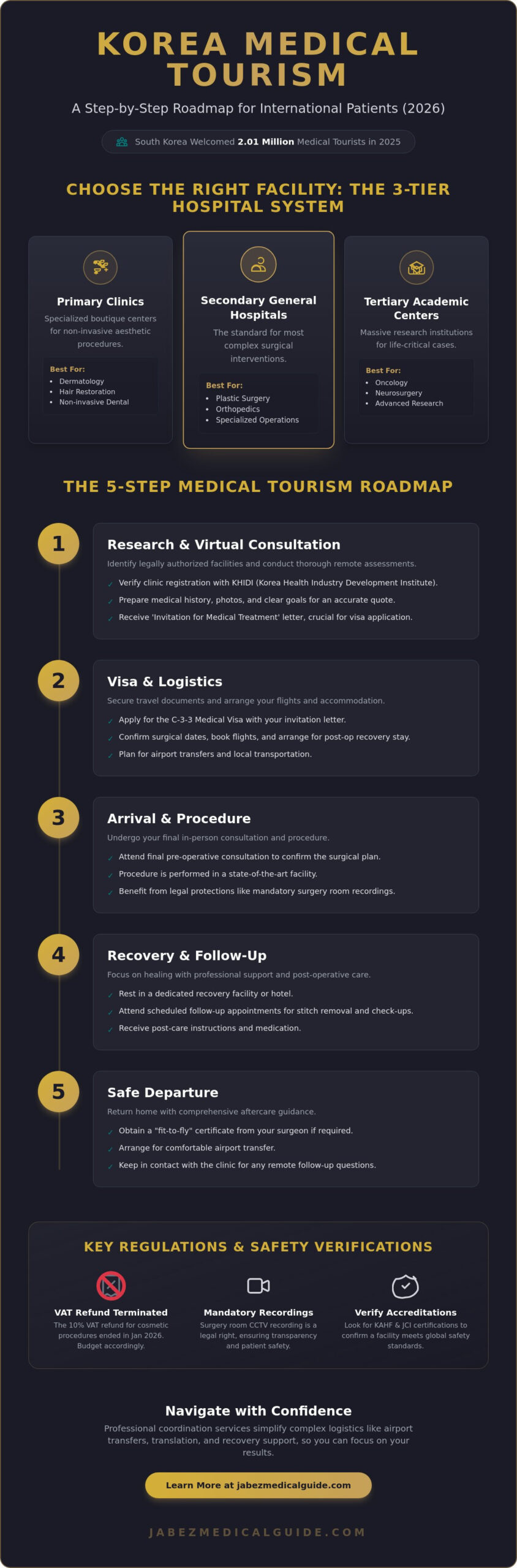
A successful korea medical tourism process depends on choosing the correct hospital level for your procedure. The system is categorized into three distinct tiers:
- Primary Clinics: These are specialized boutique centers. They’re the best choice for dermatology, hair restoration, and non-invasive dental work where personalized, aesthetic care is the priority.
- Secondary General Hospitals: These facilities serve as the backbone for complex surgical interventions. They offer dedicated operating rooms and sophisticated in-patient recovery suites for procedures requiring more intensive monitoring.
- Tertiary Academic Centers: These are massive institutions focused on oncology, neurosurgery, and advanced research. While they have incredible resources, they’re typically reserved for life-critical medical cases rather than elective aesthetic treatments.
The 5-Step Korea Medical Tourism Process Roadmap
Organizing a medical trip requires a methodical approach to ensure safety and satisfaction. The korea medical tourism process is best viewed as a chronological journey divided into five distinct phases. By following this roadmap, you minimize the risk of logistical errors and maximize your focus on healing.
Your journey begins long before you arrive at Incheon International Airport. During Phase 1, focus on identifying institutions registered under the Korea Health Industry Development Institute (KHIDI). This ensures the facility is legally authorized to treat international patients. Once you’ve shortlisted specialists, Phase 2 involves virtual consultations. Prepare a clear medical history, current photographs, and a list of specific goals to help the clinical team provide an accurate assessment.
Research and the Virtual Consultation Phase
Evaluating a medical quote is more than just looking at the bottom line. Since the 10% VAT refund for cosmetic procedures was terminated in January 2026, you’ll need to ensure your budget reflects the full price inclusive of tax. You must confirm what the quote includes, such as anesthesia fees and post-operative follow-up visits. A vital outcome of this phase is receiving the ‘Invitation for Medical Treatment’ letter. This document is essential for those applying for a C-3-3 medical visa, bridging the gap between your initial research and Phase 3 administrative logistics.
Arrival and In-Person Evaluation
Phase 4 begins the moment you land. The first 24 hours are often the most stressful, involving airport transfers and hospital check-ins. Having a pre-arranged coordination partner can significantly ease this transition, ensuring you’re not navigating a new city while anxious about your procedure.
The final in-person consultation is the most critical part of the korea medical tourism process. This is when your surgeon performs physical examinations that a camera cannot capture during a video call. It’s the time to finalize surgical plans and confirm your legal rights, such as requesting a CCTV recording of your procedure if general anesthesia is used.
After the procedure, Phase 5 focuses on supervised recovery. You’ll need to navigate the local pharmacy system for prescriptions, which often requires specific hospital-issued documentation. Planning your nutrition is equally important during this phase; understanding the best korean food for surgery recovery can help minimize post-operative swelling and accelerate wound closure. Before heading home, a final check-up is required to obtain medical clearance for your flight. This ensures you’re stable enough for air travel and have all the necessary documentation for your return journey.
Navigating Practical Barriers: Visas, Language, and Logistics
Successfully completing the korea medical tourism process requires more than just clinical selection; it demands a clear understanding of the administrative and linguistic hurdles unique to the region. While the medical care is world-class, the logistics of entry and communication can be complex without proper preparation. Addressing these practical barriers early ensures your journey remains focused on your health and recovery rather than paperwork or confusion.
The C-3-3 Medical Visa is a specific requirement for many international patients. For 2026, the application fee for a single-entry visa for a stay of less than 90 days is USD 40, while a stay exceeding 91 days costs USD 60. These fees are confirmed through June 30, 2026. You’ll need to coordinate with your chosen hospital to receive an official ‘Invitation for Medical Treatment’ letter, which is the foundational document for your visa application. It’s also vital to update your budget for 2026: as of January 1, 2026, the 10% VAT refund for cosmetic and aesthetic treatments for foreign tourists has been officially terminated. You should now plan for the full price of procedures, inclusive of the 10% VAT, as this refund is no longer available.
Professional translation is a legal requirement for informed consent in many Korean hospitals to ensure you fully grasp the risks and benefits of your procedure. This regulation protects your rights and ensures that no detail is lost in the transition between languages.
The Essential Role of Medical Translation
Conversational English is often insufficient for the high-stakes environment of a surgical suite. Certified medical translators in Korea bridge the gap between basic communication and the technical terminology found in surgical consent forms. These professionals mitigate the risk of post-operative misunderstandings by ensuring every instruction is perfectly clear. They also help you manage the ‘Pali-Pali’ (quick) culture of Korean medicine, where clinical rounds move at a fast pace. Having an advocate who speaks the language ensures your questions are prioritized and answered thoroughly.
Managing Your Stay and Local Logistics
Selecting recovery-friendly accommodation is a critical component of the korea medical tourism process. It’s best to book lodging within the immediate medical districts like Gangnam or Seocho to minimize travel time for follow-up appointments. Many patients now use digital health apps to track their medication schedules and store digital copies of their prescriptions. For the most comfortable experience, consider arranging specialized airport pick-up and drop-off services. These services provide vehicles suited for post-surgical comfort, allowing you to avoid the physical strain of navigating public transportation or standard taxis while you are in the early stages of healing.
Verification and Safety: Standards of Korean Medical Excellence
Safety is the cornerstone of a successful korea medical tourism process. South Korea maintains some of the world’s most stringent medical regulations, but you must know how to verify these standards yourself. The government’s primary tool for this is the Korean Accreditation Program for Hospitals Serving Foreign Patients (KAHF). This specific accreditation evaluates not just clinical quality, but also non-clinical services like translation accuracy and emergency protocols tailored for international visitors. While many top-tier hospitals also hold Joint Commission International (JCI) accreditation, KAHF is the most relevant indicator of a facility’s commitment to the global patient experience.
Verification extends to the individual practitioners as well. You can verify a surgeon’s board certification through official government portals to ensure they’re specialized in the specific procedure you’re seeking. Only government-registered agencies can legally facilitate international patients in Korea. This is a critical legal protection; working with unregistered “brokers” leaves you without government-backed recourse if a dispute arises. To ensure your journey is managed by a legitimate partner, you can verify professional coordination services that adhere to these strict national standards.
If a complication occurs, the Medical Malpractice Dispute Mediation and Arbitration Agency (K-MEDI) serves as a dedicated body to resolve conflicts fairly. This agency provides a structured path for mediation that is faster and more accessible than traditional litigation. Under the “Act on Support for Overseas Expansion of Healthcare System,” all registered medical institutions catering to foreign patients must also carry mandatory malpractice liability insurance.
Identifying Accredited Medical Institutions
When browsing a hospital’s website, look for the ‘International Patient Attraction’ certificate issued by the Ministry of Health and Welfare. There’s a vital difference between a ‘registered’ clinic and a ‘certified’ one. While registration is a baseline legal requirement, certification through programs like KAHF indicates the facility has passed an additional, voluntary rigorous inspection. This level of accreditation is your primary assurance of superior surgical outcomes and patient safety during the korea medical tourism process.
Patient Rights and Legal Recourse
You have the legal right to a detailed breakdown of costs before any treatment begins to avoid hidden fees. Your data privacy is also protected by Korea’s strict Personal Information Protection Act, which applies to your medical records even after you leave the country. Since 2023, patients undergoing surgery under general anesthesia also have the legal right to request a CCTV recording of their procedure. This law is now a standard practice in 2026, providing an extra layer of transparency and peace of mind. If a complication occurs after you return home, these records and the mandatory insurance coverage provide a clear framework for post-operative recourse and support.
Optimizing Your Journey with a Professional Medical Concierge
Choosing to travel for healthcare is a significant decision. While the clinical standards in Seoul are exceptional, the logistical burden of managing a trip alone can detract from your healing. A medical concierge seoul acts as your dedicated navigator, ensuring that every administrative and personal need is met with precision. This partnership is particularly essential for first-time travelers who may find the fast-paced nature of Korean medical institutions overwhelming.
Specialized agencies bridge the gap between Western expectations and Korean medical culture. In many Western countries, patients expect long, conversational appointments. In Korea, the system is designed for high-volume efficiency, often referred to as the ‘Pali-Pali’ culture. A concierge ensures you get the time you need for questions while respecting the local clinical flow. By letting experts handle the logistics, you reduce travel stress and can focus entirely on your recovery.
The value of end-to-end management cannot be overstated. From the initial stages of the korea medical tourism process, where you need medical visa assistance, to 24/7 recovery monitoring, a professional team provides a steadying influence. This support alleviates the uncertainty of navigating a foreign healthcare system and ensures that your journey is as smooth as possible.
Personalized Support with Jabez Medical Guide
At Jabez Medical Guide, we operate with a ‘Patient-First’ philosophy. We don’t simply refer you to the largest facility; we match you with the specific specialist whose expertise aligns with your medical goals, whether you require hair restoration, dental work, or plastic surgery. Our team provides comprehensive concierge services, covering everything from medical visa assistance to airport pick-up and drop-off in specialized vehicles. We prioritize transparency, ensuring you understand hospital selection criteria and pricing structures before you ever leave home. This methodical approach builds trust and ensures you feel supported at every turn.
Ensuring a Safe and Successful Recovery
Recovery is the most vulnerable phase of the korea medical tourism process. Integrating professional post-op care services korea into your travel itinerary provides a safety net that standard hotels cannot offer. We help bridge the communication gap between your Korean surgeon and your primary physician back home, ensuring your medical records are translated and transferred accurately. Finally, we coordinate your final medical clearance to confirm you’re physically fit for the flight home. This attention to detail ensures that you return home not just with the results you desired, but with the peace of mind that your health was managed with the highest standards of care.
Taking the First Step Toward Your Transformation
You now have the comprehensive roadmap needed to navigate the korea medical tourism process with absolute confidence. By understanding the hospital hierarchy and staying informed about 2026 regulatory updates, you’ve removed the primary barriers to a successful journey. Safety remains your highest priority; knowing how to verify KAHF accreditation and legal protections like mandatory surgery recordings ensures you’re choosing clinical excellence over uncertainty.
Jabez Medical Guide acts as your reliable navigator through every phase of this complex system. As a government-approved medical tourism agency, we provide certified medical translators and maintain elite partnerships with JCI-accredited hospitals to guarantee your peace of mind. We invite you to start your stress-free medical journey with Jabez Medical Guide today. From medical visa assistance to specialized recovery support, we manage the intricate logistics so you can focus entirely on your healing and results. Your path to world-class care is ready when you are.
Frequently Asked Questions
Is the Korean healthcare system free for international tourists?
No, the Korean healthcare system isn’t free for international patients. While residents are covered by National Health Insurance, foreign visitors operate within a private-pay sector where they pay for services directly. You should also plan for the full cost of your treatments, as the 10% VAT refund for cosmetic and aesthetic procedures was officially terminated on January 1, 2026.
Do I need to speak Korean to get surgery in South Korea?
You don’t need to speak Korean to access high-quality care, but having a professional interpreter is a legal requirement for informed consent in many hospitals. Most premier institutions have international departments, but these can be fast-paced. Using a coordination service ensures you have a dedicated medical translator in Korea who can clearly explain complex surgical terms and advocate for your needs during consultations.
How do I apply for a Korean medical visa (C-3-3) in 2026?
You apply for a C-3-3 visa by first securing a formal ‘Invitation for Medical Treatment’ from a government-registered hospital. This document is a cornerstone of the korea medical tourism process. For 2026, the single-entry visa fee is USD 40 for stays under 90 days and USD 60 for longer stays. You’ll submit these documents along with proof of financial stability to your local Korean embassy.
Can I use my international health insurance in Korean hospitals?
Most Korean hospitals require international patients to pay for elective procedures upfront and don’t accept direct billing from foreign insurance providers. You’ll need to check with your insurance company to see if they offer reimbursement for overseas medical expenses. Always request a detailed, English-language receipt and medical report from the hospital to facilitate any potential claims when you return home.
What is the difference between a clinic and a general hospital in Korea?
Clinics are smaller, specialized centers that focus on outpatient treatments like dermatology, dental work, or hair restoration. General hospitals are larger, secondary-tier facilities equipped with intensive care units and specialized wards for complex surgical recovery. The korea medical tourism process often involves matching your specific procedure to the correct tier to ensure you have access to the necessary medical infrastructure.
How can I verify if a Korean plastic surgeon is board-certified?
You can verify a surgeon’s credentials by checking their registration through the Ministry of Health and Welfare’s official portals. Look for the ‘International Patient Attraction’ certificate on the clinic’s website, which indicates they’re legally authorized to treat foreign patients. Registered coordination agencies can also assist in verifying a doctor’s specialization and board status to ensure they’re qualified for your specific surgery.
Is it safe to travel alone to Korea for a medical procedure?
Korea is exceptionally safe for solo travelers, but managing the physical demands of recovery alone can be difficult. It’s helpful to arrange professional airport pick-up and drop-off services to avoid the strain of public transportation after surgery. Many solo patients also utilize recovery support services to ensure they have assistance with medication schedules and follow-up appointments during the first few days of healing.
What happens if I have a medical emergency in Korea as a foreigner?
You should dial 119 immediately for any medical emergency in South Korea. Registered hospitals that cater to international patients are required by law to have mandatory malpractice liability insurance. These institutions have established protocols for handling emergencies involving foreign visitors, ensuring you receive immediate clinical attention while your coordination team manages the communication with your family or home physician.