

What if the safety of your procedure had nothing to do with a clinic’s social media following and everything to do with a government-mandated camera lens? You’ve likely heard the unsettling stories about “ghost doctors” or felt the weight of anxiety that comes with visiting a medical system in a language you don’t speak. It’s completely natural to ask is plastic surgery in korea safe when you’re planning a life-changing journey thousands of miles from home. You deserve more than marketing promises; you deserve a framework built on verifiable standards and professional oversight.
We understand that true peace of mind comes from transparency and meticulous planning. This guide explores the 2026 reality of the South Korean medical landscape, where rigorous safety standards and legal protections are now the baseline for international care. You’ll learn how to identify KAHF-accredited hospitals, understand your rights regarding mandatory operating room CCTV, and navigate the recent 2026 policy changes affecting surgical pricing. We provide a clear path to help you distinguish between high-volume clinics and the specialized, government-registered institutions that prioritize your health. This overview ensures your journey is defined by clinical excellence and the security of a well-organized plan.
Key Takeaways
- Learn how to verify Ministry of Health and Welfare (MOHW) registration and KAHF accreditation to ensure your clinic meets national safety standards.
- Understand how the 2026 legal mandate for operating room CCTV provides you with a definitive safeguard against “ghost surgery” and unauthorized practitioners.
- Discover why is plastic surgery in korea safe for patients who prioritize clinics with a resident anesthesiologist and specialized surgical teams rather than high-volume “factory” clinics.
- Gain a clear framework for using professional coordination services to audit hospital credentials and bridge critical language gaps that could lead to surgical errors.
The Global Standard: Is Plastic Surgery in Korea Safe for International Patients?
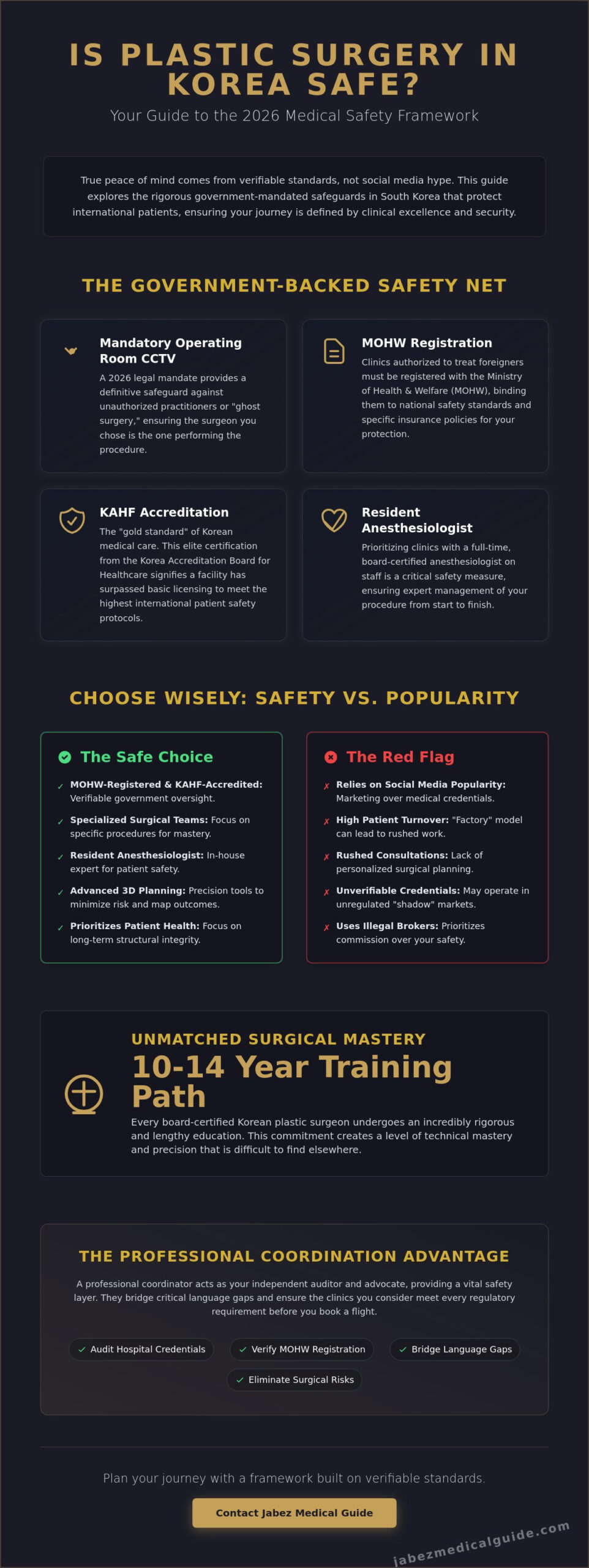
Safety in a medical context is a measurable standard rather than a vague feeling. It exists where technical surgical mastery meets sterile clinical environments and robust legal accountability. Many international patients arrive in Seoul asking the same fundamental question: is plastic surgery in korea safe? The answer is found in the country’s sophisticated medical infrastructure. While Cosmetic surgery in South Korea is a globally recognized industry, your personal safety depends on choosing government-vetted institutions over those that rely solely on aggressive marketing. In 2026, the primary risk isn’t a lack of technology, it’s the choice between high-volume “factory” clinics and specialized centers. Professional coordination provides a vital safety layer by acting as an independent auditor, ensuring the clinics you consider meet every regulatory requirement before you ever book a flight.
Why Korea Maintains the Worlds Highest Density of Specialists
Technical skill in the Korean medical community is the result of an incredibly rigorous education system. Most board-certified plastic surgeons undergo a 10 to 14 year training path before they’re permitted to lead a surgical team. This long-term commitment creates a level of technical mastery that is difficult to find elsewhere. The high concentration of clinics in Seoul’s central medical districts creates a competitive environment that forces constant improvement. By 2026, this competition has made advanced 3D imaging and precision surgical planning systems the baseline standard rather than a premium feature. These tools allow surgeons to map out every incision and structural change with mathematical accuracy, which significantly reduces the risk of unexpected complications during the procedure itself.
Safety vs. Popularity: Understanding the Distinction
It’s easy to confuse a clinic’s social media popularity with its clinical safety record. Trending clinics often focus on high patient turnover, which can lead to rushed consultations or generic results. Accredited institutions, however, prioritize long-term health and structural integrity. A common misconception is that a higher price tag automatically guarantees a safer experience. In reality, safety is tied to registration and oversight. The Ministry of Health and Welfare maintains strict control by requiring all clinics treating foreign visitors to register and adhere to specific safety protocols. When you look beyond the marketing, you’ll find that is plastic surgery in korea safe is a question answered by a clinic’s adherence to these national standards. Verification of these credentials is the most effective way to protect yourself from the risks associated with unvetted “shadow” clinics.
Decoding the Korean Medical Regulatory Framework
The regulatory framework in Seoul is designed to eliminate the guesswork from your medical journey. Every clinic authorized to treat foreign visitors must display their Ministry of Health and Welfare (MOHW) registration number. This isn’t just a formality; it’s a legal requirement that binds the clinic to national safety standards. By 2026, the government has mandated that these clinics carry specific insurance policies to protect international patients. This shift addresses the common concern of whether is plastic surgery in korea safe for those who don’t have local legal standing. You can easily verify these registration numbers on the Ministry’s official website to ensure you’re stepping into a legitimate, insured facility.
While the majority of the industry operates with high integrity, some dodgy practices pose risks in the unregulated shadows of the market. These often involve illegal brokers who prioritize commissions over patient safety. A registered clinic is legally accountable to the MOHW, which provides a layer of protection that doesn’t exist with unvetted providers. Understanding these legal requirements helps you move from a place of uncertainty to one of informed confidence.
The KAHF Shield: What It Means for You
The KAHF accreditation is the gold standard of Korean medical care. It’s an elite certification that goes far beyond basic licensing. To qualify, clinics must prove excellence in five core areas:
- Advanced emergency response systems including crash carts and backup power.
- Rigorous sterilization protocols and infection prevention measures.
- Dedicated medical translation staff to ensure clear communication.
- Transparent financial records and ethical marketing practices.
- Post-operative care facilities that meet hospital-grade standards.
Look for the official KAHF logo on a clinic’s website. It acts as a shield, indicating that the facility has passed a comprehensive government audit that most high-volume clinics cannot survive. Only a small percentage of institutions earn this elite seal, making it a primary indicator for anyone asking is plastic surgery in korea safe.
Verifying Surgeon Credentials: Board Certification 101
Understanding the difference between a general practitioner and a specialist is vital for your safety. In Korea, a board-certified plastic surgeon has completed years of specialized residency training that general doctors lack. You should always verify your surgeon through the Korean Society of Plastic and Reconstructive Surgeons (KPRS) database. A major red flag occurs if a clinic refuses to disclose a surgeon’s specific board identification number. Using a specialized coordination service allows you to bypass these risks by accessing pre-vetted databases of elite specialists who have maintained clean safety records.
Busting the Ghost Surgery Myth and Modern Safeguards
The fear of “ghost surgery” was once a significant source of anxiety for international patients. This term refers to the illegal practice where a substitute doctor performs the procedure while the patient is under anesthesia, rather than the surgeon who conducted the initial consultation. By 2026, the South Korean government has effectively dismantled this risk through aggressive legislative action and technological mandates. The mandatory implementation of CCTV in operating rooms is now a universal legal right for any patient undergoing general anesthesia or any state of unconsciousness. This transparency provides a definitive answer for those wondering is plastic surgery in korea safe in the current year. You no longer have to rely on trust alone; you have the legal right to request and verify a video recording of your entire procedure before you even sign your final consent form.
Professional medical translators also play a vital role in this new era of transparency. Beyond simply bridging the language gap, they act as objective witnesses within the clinical environment. They ensure that the surgical plan you agreed upon is the one being communicated to the entire medical team. This human layer of oversight, combined with the “Surgeon-Match” guarantee found in reputable clinics, ensures the doctor you trust is the doctor who operates.
OR Transparency: Your Right to Surveillance Footage
Reputable clinics in 2026 have moved beyond basic compliance to offer total transparency. The legal process for requesting surgery recordings is now streamlined, allowing patients or their legal representatives to view footage if any concerns arise. Many top-tier institutions have also introduced “Real-Time Monitoring” systems. These allow family members or your professional coordinator to watch a live, secure feed of the surgery from a private waiting area. Reputable clinics now use fingerprint or biometric OR access for surgeons to ensure only authorized, assigned medical staff can enter the sterile zone. These digital audit trails make it virtually impossible for unauthorized practitioners to participate in your care.
Avoiding “Medical Factories”: The High-Volume Trap
Identifying a “medical factory” is a critical skill for any safety-conscious patient. These clinics often prioritize high patient turnover, which is a major factor in determining if is plastic surgery in korea safe for your specific needs. You can spot these facilities by their rushed consultations, excessive “same-day” discounts, and a lack of direct access to the surgeon during the recovery phase. Personalized care is a fundamental safety feature, not a luxury. Boutique clinics often adhere to a “One Surgeon, One Day” philosophy, which prevents surgeon fatigue and ensures your doctor is fully focused on your anatomical details. Choosing a clinic that limits its daily procedures significantly reduces the risk of technical errors and post-operative complications.
The International Patients Safety Checklist for 2026
Moving from the theoretical understanding of regulations to the practical reality of your surgery requires a structured approach. Your safety is built on a series of verifiable steps that happen before you ever enter the operating room. When evaluating whether is plastic surgery in korea safe for your specific procedure, you should use a rigorous checklist to audit your chosen facility. This process transforms a complex medical journey into a manageable sequence of safety checkpoints. By 2026, these standards have become the baseline for elite institutions, but it remains your responsibility to confirm them.
- Step 1: Confirm MOHW Registration. Every clinic authorized to treat international visitors must be registered with the Ministry of Health and Welfare. This registration ensures the clinic is subject to regular government inspections and adheres to the latest 2026 medical laws.
- Step 2: Verify the Anesthesiologist-in-Residence. A safe clinic does not rely on “on-call” anesthesiologists who travel between multiple locations. Your facility must have a dedicated specialist who remains on-site for the duration of your procedure and recovery.
- Step 3: Audit Emergency Response Equipment. High-standard clinics are equipped with advanced life-support hardware, including automated external defibrillators (AEDs) and Uninterruptible Power Supply (UPS) systems to maintain surgical equipment during power failures.
- Step 4: Review Post-Operative Monitoring. Safety doesn’t end when the incisions are closed. Ask for a detailed protocol of how you’ll be monitored in the first 24 hours, including the credentials of the nursing staff in the recovery wing.
- Step 5: Validate Your Medical Coordinator. Ensure your facilitator is a government-certified agency. A professional plastic surgery coordination service acts as your advocate, verifying these technical details so you don’t have to navigate the medical jargon alone.
Evaluating Anesthesia Safety
Anesthesia is often the most critical variable in surgical safety. Having a dedicated, full-time anesthesiologist is non-negotiable for any procedure involving sedation or general anesthesia. During long operations, a resident specialist monitors your vital signs in real-time, adjusting dosages instantly based on your body’s response. This differs significantly from local sedation protocols, which require less intensive monitoring but still demand professional oversight. You should always ask if the anesthesiologist will be present in the room from the moment you go under until you’re fully conscious in recovery.
Emergency Preparedness and Hospital Proximity
The most secure clinics operate with a “worst-case” mindset. This means they maintain formal transfer agreements with nearby university hospitals or trauma centers. If a rare complication occurs, these agreements ensure immediate admission to an intensive care unit. Checking for on-site emergency kits and ICU-grade monitoring equipment provides a final layer of reassurance. Emergency readiness is the ultimate mark of a safe clinic. It demonstrates that the institution values your life more than the efficiency of its surgical schedule.
How Professional Coordination Eliminates Safety Risks
Safety isn’t just about what happens in the operating room. It’s about the entire infrastructure surrounding your care. Many people ask is plastic surgery in korea safe, but they often forget to consider the “Recovery Gap”—the critical period after discharge but before you return home. A professional facilitator like Jabez Medical Guide acts as an independent auditor of clinics. We verify that the high standards mentioned in previous sections are actually met in practice. This concierge approach ensures that you’re never navigating the complex Korean medical system alone. By managing the logistics of your journey, we allow you to focus entirely on your healing process.
Professional medical translation is another vital safety feature that shouldn’t be overlooked. Miscommunication during a consultation can lead to irreversible surgical errors or results that don’t match your expectations. Our specialized coordinators ensure that every nuance of your medical history and aesthetic goals is perfectly understood by the surgical team. This level of precision eliminates the risks associated with language barriers and provides a clear, documented record of your consent. It functions as a protective layer, ensuring that the surgical plan remains consistent from the first meeting to the final incision.
The Value of an Independent Advocate
We act as a filter, removing clinics with poor safety records or pending litigation from your options. This objective oversight is essential because marketing materials don’t always reflect clinical reality. We also verify the authenticity of “Before & After” photos to ensure they represent genuine outcomes from the specific surgeon who will be treating you. Our role is to provide transparency in an industry that can sometimes feel opaque to foreigners. For a deeper look at these standards, explore The 2026 Comprehensive Guide for International Patients.
Post-Operative Support and Emergency Access
Your journey doesn’t end when you leave the hospital doors. Recovery support services provide a vital bridge between the clinic and your safe return home. If a concern arises at 3 AM in your hotel room, having a local navigator ensures you get immediate answers or are redirected to medical attention if necessary. We coordinate your follow-up appointments and stitch removals with meticulous precision, ensuring that the healing process stays on track. Our team also manages your airport pick-up and drop-off to minimize physical strain during the most delicate days of your recovery. Before you depart, we facilitate a thorough “Fit-to-Fly” assessment. This ensures your body is stable enough for the pressure changes of air travel. This level of comprehensive organization is what truly defines if is plastic surgery in korea safe for your specific international journey.
Your Path to a Confident and Secure Transformation
You now have a clear framework to navigate the modern Korean medical landscape with confidence. The transition toward mandatory operating room CCTV and the elite KAHF accreditation standards demonstrates a national commitment to your well-being. While it’s natural to ask is plastic surgery in korea safe, the answer depends on your ability to distinguish between marketing-heavy clinics and government-vetted institutions. By following the 2026 safety checklist and insisting on transparent credentials, you’re already ahead of the curve.
We’re here to act as your steadying influence throughout this entire process. As a government-approved medical tourism agency, we maintain partnerships exclusively with KAHF-accredited institutions and provide certified medical interpreters for every procedure. It’s our mission to ensure your journey is organized, transparent, and entirely focused on your comfort. You can consult with a Jabez Medical Expert to verify your chosen clinic’s safety record today. Your journey toward a radiant new version of yourself is a path you don’t have to walk alone.
Frequently Asked Questions
What legal rights do foreigners have if something goes wrong during surgery in Korea?
International patients have the right to seek resolution through the Korea Medical Dispute Mediation and Arbitration Agency (K-MEDI). This government body offers a structured mediation process that is much faster and more accessible than traditional litigation. You’re also legally entitled to copies of your medical records and any mandated operating room recordings to support your claim if a dispute arises.
How can I tell if a Korean plastic surgeon is truly board-certified?
You can verify a surgeon’s credentials by checking the Korean Society of Plastic and Reconstructive Surgeons (KPRS) database. A board-certified specialist has completed a rigorous 10 to 14 year training path, which is distinct from general practitioners who may perform cosmetic tasks. Look for the official “Certified Specialist” seal on their profile or ask to see their board identification number during your consultation.
Is it safer to go to a large hospital or a small boutique clinic in Korea?
Safety depends on accreditation and resident staffing rather than the size of the facility. Large hospitals often have more extensive on-site emergency equipment, while boutique clinics may offer a “One Surgeon, One Day” focus that prevents surgeon fatigue. Both are safe choices if they hold KAHF accreditation and employ a full-time, resident anesthesiologist rather than an on-call doctor.
What is “Ghost Surgery” and is it still a problem in 2026?
Ghost surgery is the practice of a substitute doctor performing a procedure instead of the lead surgeon, but it’s been largely eliminated by the 2026 mandatory CCTV laws. These laws give every patient undergoing general anesthesia the legal right to have their surgery recorded. When patients ask is plastic surgery in korea safe today, the presence of these transparent monitoring systems provides the most definitive answer.
Does the Korean government compensate international patients for malpractice?
The government doesn’t pay out compensation directly, but they’ve mandated that all clinics attracting foreign patients carry specialized medical malpractice insurance as of 2026. This insurance is a prerequisite for their registration with the Ministry of Health and Welfare. It ensures that if mediation through K-MEDI proves a medical error, there are insured funds available to cover your settlement and recovery costs.
Why is a medical translator necessary for my safety?
A certified medical translator is your primary advocate for preventing surgical errors caused by miscommunication. They ensure your specific anatomical goals and medical history, such as drug allergies, are perfectly understood by the entire surgical team. In 2026, these professionals also act as objective witnesses who can verify that the surgical plan discussed in your consultation is the one being executed.
Are Korean anesthesia standards the same as in the US or UK?
Korean anesthesia protocols are comparable to the highest standards in the US and UK, utilizing the same advanced monitoring technology and medications. The safety of your procedure relies on the presence of a resident anesthesiologist who remains in the room for the entire duration of the surgery. Reputable Korean clinics prioritize this specialized oversight to manage your vitals and sedation levels with clinical precision.
Can I see the operating room CCTV footage of my procedure?
You have a legal right to request and view the CCTV footage of your surgery if it involved general anesthesia or any state of unconsciousness. This right is now a fully established part of the 2026 medical regulatory framework in South Korea. It’s best to confirm this request before signing your final consent form to ensure the clinic has the recording ready for your review if needed.